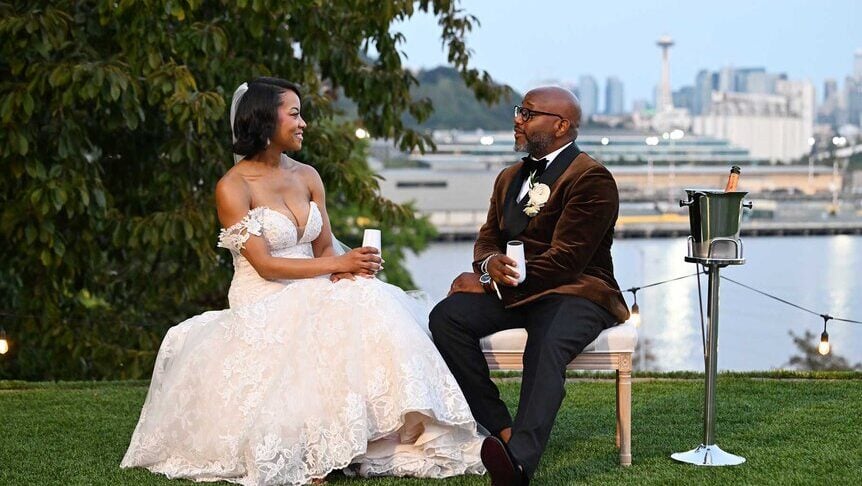
“Married at First Sight” debuted on Peacock on July 16, introducing 20 new singles and at least one headline-making couple.
Season after season, viewers tune in to their favorite reality TV shows, expecting drama but deep down hoping for love. Yet for many Black women watching “Married at First Sight,” the season 20 premiere felt like the start of another familiar disappointment.
“Married at First Sight” season 20 premiered last week, introducing 14 new singles based in the Seattle area, willing to marry a total stranger, sight unseen, in the name of finding everlasting partnership. Among them are two Black couples, Bellejolie Force (28) and Mecca Amen (28), and Nikki Jefferson (46) and Shawn Best (47), though it is the latter who have already taken over much of the online discussion.
Following the three-part premiere on Thursday, July 16, on Peacock, viewers immediately began dissecting Jefferson and Best’s first meeting at the altar. From Jefferson’s less-than-enthused reaction and the pair’s awkward lack of chemistry to Best seemingly missing several of the qualities she said she was looking for, fans are already wondering if they are watching yet another example of a reality dating show playing in Black women’s faces. Or is this simply all just part of the experiment?
Trouble began immediately. As Jefferson, an HR lead, walks down the aisle to the cheers of family and friends, she looks around awkwardly and whispers to producers, “I’m ready,” before asking something to the effect of, “Am I supposed to wait for my husband?” Moments later, she realizes Best, a college VP of admissions, has been standing in front of her the entire time, visibly shocked as the ceremony begins.
The awkwardness only continues from there. Jefferson learns that Best is not a medical doctor but holds a doctorate in education. He also doesn’t match the height or physical type she previously described, and, at least in the early moments of their interaction, their personalities don’t seem to naturally mesh. His boyish sense of humor didn’t go over well when he jokingly asked if they would 69 on their wedding night, and so forth.
Online, the reactions have been mixed. While many hope she can get past the physical, as one is expected to be willing to look beyond the physical for the premise of the show, viewers have pointed out just how far Best seems to fall short of the qualities Jefferson said she wanted, questioning whether producers intentionally created a mismatch in pursuit of compelling television or whether Jefferson may simply have been withholding what she truly values.
The frustration in watching a mismatched pairing hits differently for many Black viewers. While disappointing pairings are hardly unique to Black contestants, this storyline arrives within a much longer history of Black people, and particularly Black women, feeling as though they have not been afforded the same care, romance, happy endings, or decent edits on reality television. Although representation has improved over the past decade, marriage rates in the United States continue to decline overall, and Black women remain the demographic most likely to be unmarried. Against that backdrop, storylines like this inevitably strike a chord.
Reality dating shows aim to reflect real-life relationships for viewers with greater authenticity and realism than scripted romantic dramas. When a Black woman appears to be paired with someone who falls well outside of what she clearly communicated she wanted, it can reinforce a familiar and frustrating message that Black women should simply settle for the pursuit of love.
It is hardly a new conversation. In books and public discussions about the state of Black dating and marriage, Black women have repeatedly been encouraged to either lower their standards, accept a “project,” or date outside their race rather than expecting Black men to meet them where they are. That argument has long been met with resistance from Black women who reject the idea that settling should be the price of partnership.
Of course, it is also important to remember that viewers are watching an edited television show, not real life in its entirety. Producers have hours upon hours of footage and shape it into the most compelling story possible. A 46-year-old Black woman with seemingly high standards navigating an increasingly uncomfortable match makes for entertaining television, one has to admit. Peacock is, after all, a platform built on highly produced reality programming where conflict often drives the story.
Still, it is fair to ask whether the entertainment has to come at the expense of a Black couple. From what viewers have seen so far, both Jefferson and Best appear to be accomplished, thoughtful people who have lived full, interesting lives. Both deserve partners who appreciate them for who they are, not for who they wish they could become.
And to be clear, this isn’t just unfair to Jefferson. It is also unfair to Best, who has to watch someone visibly struggle to be excited about being with him. If the pairing was engineered for entertainment, the emotional cost isn’t one-sided. Both people become collateral damage in a storyline they didn’t write.
Their story, however, is only just beginning. A stronger connection could develop as they spend more time together. They did, after all, just meet. It is equally possible that the relationship never finds its footing. Either way, one thing already seems certain: the viewers will be tuned in.
More About:Lifestyle
Weekly New Episodes
Stream Now