

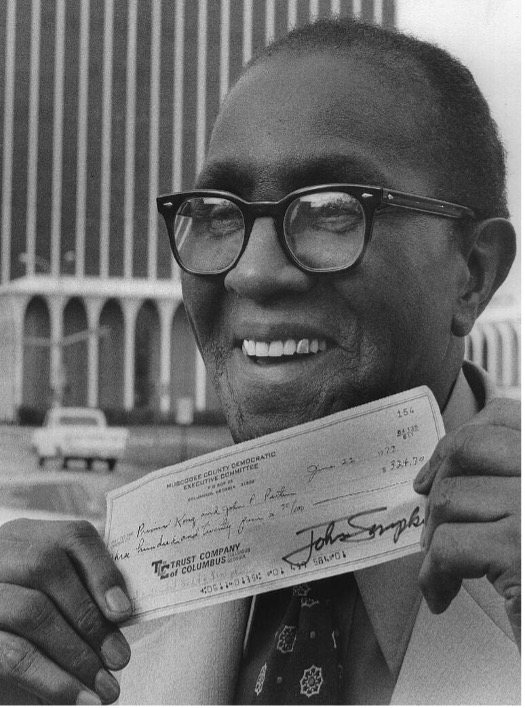
Rev. Primus E. King was a Columbus, Georgia, barber and ordained minister who fundamentally transformed voting rights in Georgia by successfully dismantling the state’s white-only Democratic primary.
Born February 5, 1900, in the unincorporated community of Hatchechubbee in Russell County, Alabama, to a sharecropping family, King later etched his name in the annals of American democracy. Because of segregation and poverty, King received no formal education, and after moving 22 miles east to Columbus, Georgia, he worked for the Meritas cotton mill and later as a chauffeur and butler before learning the trade of barbering and purchasing his own shop. In 1921, he married Genie Mae King, a public-school teacher. Following a religious conversion, King became an ordained Baptist minister in 1939, serving as pastor of Mt. Pleasant Baptist Church and later Salem Baptist Church.
On July 4, 1944, King, a registered voter, attempted to cast a ballot in the Democratic Party primary at the Muscogee County Courthouse in Columbus. Met with recalcitrance from a law officer, he was turned away. Working alongside civil rights leader Dr. Thomas Brewer and white attorney Oscar D. Smith Sr., King filed a federal lawsuit, King v. Chapman et al alleging that denying his right to vote violated the 14th, 15th, and 17th amendments.
In October 1945, Federal Judge Thomas Hoyt Davis of the Middle District of Georgia ruled in King’s favor. The decision was affirmed in March 1946 by the U.S. Fifth Circuit Court of Appeals. The impact of this legal victory effectively dismantled the legal basis for the all-white Democratic primary in Georgia, opening state and local Democratic primary elections for Black citizens across the state. Because of this legal victory, a new era dawned for Black Georgia voters. In Atlanta, the city’s Black community of 100,000 found themselves with a powerful voice in state affairs. It also led to a series of lynchings and the resurgence of White Citizens’ Council activity to stoke fear in Black communities so they would not vote. Evidence was seen through the Moore’s Ford lynching, where four Black citizens were lynched (one being seven months pregnant) on the Moore’s Ford Bridge near Monroe, Georgia, on July 25, 1946.
The post Primus E. King (1900-1986) appeared first on BlackPast.org.