

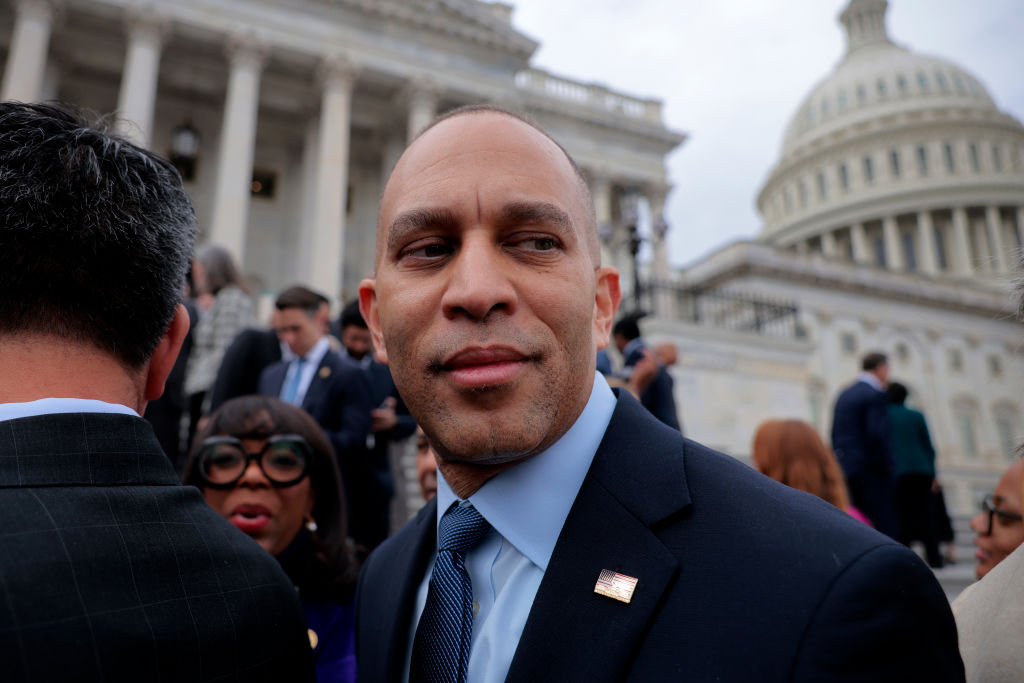
As Jeffries prepares to become the nation’s first Black House speaker, progressive demands for new leadership are clashing with calls to recognize his historic achievement.
U.S. Rep. Hakeem Jeffries (D-N.Y.) is on the verge of making history by becoming the first Black American Speaker of the United States House of Representatives, a milestone more than 200 years in the making.
“Black representation is meaningful,” says Michael Hardaway, a Democratic strategist who advises Jeffries, the House Democratic leader, and served as his communications director.
“Black folks for years have been disadvantaged and disenfranchised by this government, including when it comes to voting,” he told theGrio. “It’s critically important for Black folks around the world to be able to see that the person third in line to the presidency, the Speaker of the House, is a Black man.”
Next week Wednesday, the House Democratic Caucus will convene behind closed doors to vote on its nominee for speaker. The leadership election is done by secret ballot. Then an official vote on the House floor will take place on Jan. 3, 2027.
However, in the week following the Democratic Party’s winning a majority of House seats in the 2026 midterm elections, Jeffries is facing opposition from progressives who argue he isn’t the right person for the job.
A petition on Change.org calling for Jeffries and Senate Democratic leader Chuck Schumer to be removed from their positions has garnered more than 1 million signatures. Critics say the leaders do not represent a majority of Democratic voters, but rather a Democratic establishment backed by corporate donors.
According to political strategist Dr. Alvin Tillery, the opposition to Jeffries reflects a deeper ideological divide within the Democratic Party, one that has been building for several election cycles.
“The Democratic voter base is farther to the left than the electeds and the donors,” Tillery, a Democratic pollster and founder of 2040 Strategy Group, told theGrio.
Tillery, who advised the campaign of U.S. Rep.-elect Chris Rabb, a Democratic socialist, in Pennsylvania, argues that Democratic leaders have failed to embrace the progressive policies their voters increasingly support, including Medicare for All and stronger opposition to federal immigration enforcement. He also points to the war in Gaza—connected to the controversial role of pro-Israel lobbyists—as an issue that has contributed to frustration with the party’s establishment.
Several incoming progressive Democrats elected to Congress have expressed reservations about backing Jeffries, including Reps.-elect Claire Valdez and Darializa Avila Chevalier, both New Yorkers allied with New York City Mayor Zohran Mamdani, and Rep.-elect Melat Kiro of Colorado. However, none have outright said they won’t vote for him.
Democratic Rep.-elect Don Leonard of Ohio alleged that senior party members warned him of political retaliation if he did not back Jeffries, including the loss of committee assignments and campaign support.
The names of progressive Democratic Reps. Ayanna Pressley of Massachusetts and Jamie Raskin of Maryland have been floated as alternatives to Jeffries; however, both Democrats have expressed that they have no interest in the job.
The debate is especially complicated by Jeffries’ historic candidacy. While his election would represent a landmark achievement for Black political representation, Dr. Tillery argues that the significance of the moment should not overshadow demands for substantive policy change.
“There’s an old guard that thinks representation, them having their seats and then having a Black speaker, is frankly worth as much, if not more, than actually delivering for the people,” Tillery told theGrio.
However, Jeffries’ defenders say that argument overlooks both his record and the political realities of leading a Democratic caucus that represents districts across the ideological spectrum.
“The job of the leader of a caucus in Congress is to represent the entire body,” explained Hardaway. “That includes moderate districts. That includes conservative districts. That includes progressive districts. It includes Queens, New York, and also the middle of Nebraska.”
The Democratic strategist said that the larger issue is that many people “don’t really understand the job of a leader or the job of a speaker.” He told theGrio the current 250-plus majority that Democrats won in last week’s election was the result of Jeffries.
“We got to this majority by Hakeem identifying candidates in those red-to-blue districts that he thought [Democrats] could win. He put the resources behind them. He campaigned for them. He traveled to their districts, and that’s how we got to this majority,” said Hardaway.
Tillery called out a “moderate polling industrial complex” that downplays the Democratic Party’s progressive base.
“They do everything they can to explain it away,” he told theGrio. “They’re not going to say 92% of Black voters showed out. They’re going to credit some white voters flipping.”
Tillery expressed concern that doing so will “allow Jeffries and Schumer the cover to not go big” once they assume power.
On Friday at a Democratic conference in Denver, Colorado, Jeffries was confronted by several progressive protesters who demanded an end to Trump’s war on Iran, government-funded health care for all, and an arms embargo on Israel.
Hardaway pushed back against the idea that there’s a groundswell of progressive pushback against Jeffries, or that Jeffries isn’t progressive.
“It’s a fake grassroots movement authored by a small group of people who know how to drive a conversation online,” said the Jeffries ally, who also questioned whether the online petition’s signatures were “authentic” and accused its author of “grifting and making money” from it.
Hardaway, who said some of the “tone” of the debate over Jeffries’ leadership is “racist,” defended Jeffries’ legislative record throughout his 20-year-long career in New York and D.C. politics. He pointed to his role in bipartisan criminal justice reform, dismantling the racist stop-and-frisk policing policy, and championing affordable housing and a living wage.
“Those are the things that matter in politics. Online petitions and tweets are meaningless,” Hardaway told theGrio.
U.S. Rep. Bennie Thompson (D-Miss.), who is poised to reclaim his role as chairman of the House Committee on Homeland Security when Democrats take the majority next year, said critics of Jeffries are “entitled to an opinion.”
“Everybody’s entitled to supporting the candidate that they think who will do the best job,” Thompson told theGrio. “I just happen to disagree with the posture that Hakeem Jeffries won’t be a good speaker.”
The Mississippi Democrat credited Jeffries for shepherding the party from a minority to a large majority, asserting, “I don’t think you reward success by punishing people.”
Instead, the longtime congressman encouraged Jeffries’ critics to put their concerns on the table for debate. “That’s how you, in a democracy, work out things,” he said.
During a press conference, Jeffries embraced the debate over his potential speakership with optimism, saying he was “confident that we’re on a positive trajectory.”
The top House Democrat defended his record, pointing to his role in leading the party, despite its minority status this Congress, to force votes on key issues like the Iran war, the Epstein files, and extending Temporary Protected Status for Haitian migrants, as well as “battling” Republicans on cuts to health care and ICE funding.
“The record speaks for itself,” said Jeffries. “But that doesn’t mean it’s not important to talk to every single member of the House Democratic Caucus family about what the future looks like and how we can build upon this record.”
Rep. Thompson said he doesn’t see any conflict between the historic nature of Jeffries’ imminent speakership and his deservingness.
“I see this moment in history as one that I want to be on the right side of,” he told theGrio.
“And I just see from a historical perspective and a performance perspective that Hakeem Jeffries is that person.”
More About:Politics
Weekly New Episodes
Stream Now