

Campus queens say they can spend hundreds, sometimes even thousands of dollars out of pocket while bringing visibility to their schools.
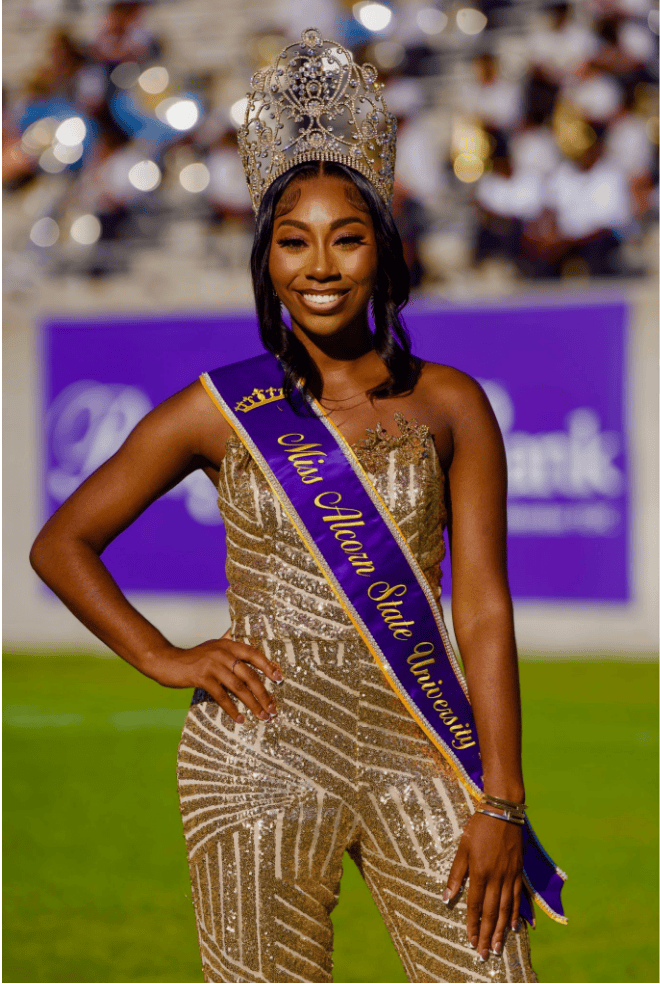
Erin Nichols, the 100th Miss Alcorn State University, poses on the field during a football game appearance. (Photo courtesy of Erin Nichols)
By Ssanyu Lukoma
WASHINGTON, D.C. — HBCU queens have embodied Black excellence, pride, and tradition since royal courts started crowning them in the late 1920s. But behind the crowns, gowns, and pageantry, there’s an often-unseen hefty price that comes with maintaining that glamorous image of campus royalty.
Campus queens say they can spend hundreds, sometimes even thousands of dollars out of pocket while bringing visibility to their schools. Some queens receive scholarships, housing benefits, and university stipends, but those benefits can still fall short of covering the true costs of wearing the crown.
Erin Nichols, a senior biology major from Alcorn State University, serves as the 100th Miss Alcorn State University, which provides free room and board for the Mister and Miss titles. Still, she said the financial demands began before she was crowned.
“As Miss Alcorn State University, I received a $2,000 stipend. I believe this amount is totally outdated and needs to be updated,” Nichols said. The stipend is supposed to cover clothes alone, but you also have to pay for hair, nails and makeup. My coronation dress alone was $1,500 out-of-pocket, and I spent my stipend before I even received it in early September because we were already buying outfits for early game days.”
Campaigning for the title brought its own price tag. Despite her university’s $2,000 cap on direct out-of-pocket expenses, Nichols said she raised $8,000 to $10,000 in total campaign donations.
Kendall Townsend is a senior communications major and serves as the 90th Miss Miles College in Fairfield, Alabama. Royal court candidates, she said, are required to raise a mandatory $1,200 campaign fund just to retain their title prior to taking office.
“If I didn’t have a good support system, I would be out of luck. I would have to pick up a part-time job, and being a queen is already a full-time job.”
At Southern University at New Orleans, Kai Lee Harris, a senior majoring in forensic science from Los Angeles, California, receives full tuition, room and board. Harris says she spent more than $1,200 campaigning for her title and another $1,500 to $2,000 after assuming the crown.
Harris is responsible for financing her own wardrobe, formal attire, hair and makeup out-of-pocket.
In a survey distributed to current and former HBCU queens representing ten institutions, respondents described the financial strain of maintaining their public image. Nearly all reported spending their own money on expenses associated with their titles, and only two respondents believed they were adequately compensated for their responsibilities.
At Howard University, concerns about royal court compensation have prompted an effort to reform how student leaders are paid. College of Arts and Sciences Senator Kourtland N. Marcotte introduced the Compensation Requiring Oversight through Willing Nomination or Election (C.R.O.W.N.) Act, a proposal that would redirect student government funds to provide stipends for 14 previously unpaid royal court members.
However, the bill was ultimately defeated during a virtual Senate meeting last month. The C.R.O.W.N. Act failed by just two votes – ending 16-to-2, short of the 18 votes required for a two-thirds constitutional majority. The bill faced heavy pushback from university administration. Walter Servance, Director of Campus Life and royal court advisor, argued that the university already provides court members with sufficient resources and clothing, framing out-of-pocket expenses for hairstyles and wardrobe changes as personal choices, rather than mandatory requirements.
Rashida Williamson, who served as Miss Clark Atlanta University during the 2017–2018 academic year, received full tuition, room, and board. But her obligations as a royal queen made it difficult to maintain outside employment.
“The time frame that I wanted to spend to actually get a job, I wouldn’t be able to, because towards evenings something’s always going on,” Williamson said. “We are required to have 10 office hours a week, plus meetings on Monday and Thursday and then game day, of course, which is an all-day thing. So 15-20 hours a week is the absolute minimum,” said Nichols.
Members of the 2026–2027 Howard University Royal Court with Ssanyu Lukoma (The 88th Miss Howard University).
At Fort Valley State University in Georgia, Ruqayya Reid, a junior agricultural engineering major from Rochester, New York, who serves as Miss Junior, says secondary court members are expected to participate in many of the same activities as the principal titleholders.
But unlike some higher-ranking court members, Reid says class queens do not receive tuition assistance, housing benefits, or wardrobe allowances. “They only have money for Miss and Mister, First and Second Attendant, and that’s about it,” Reid said.
Reid operates her own nail technician business to help cover the expenses associated with her position. “I definitely think we should matter just as much,” she said.
Miss Fort Valley State University, Blanche Taylor McClusky, is an animal science major from Cedartown, Georgia. She explained that FVSU provides principal titleholders with $2,000 toward housing and $1,000 toward a meal plan, alongside a monthly stipend, while class court officers receive no direct financial compensation.
“It used to be where housing and meal plans were fully paid for these students [Mister and Miss FVSU], but that was a really big chunk of our student activity fee going toward a limited group,” McClusky said. “It made more sense to use that money toward more services for the student body.”
While secondary court members like Reid pay out-of-pocket for all hair, nails, makeup and event programming, McClusky feels accurately compensated,” McClusky said. “However, for class officers who have fewer appearances, it would make sense for the institution to at least cover their required attire.”
Members of the Spelman College Royal Court pose together at a campus event. Pictured from left to right: Third Attendant, Zaria Samuel, Second Attendant, Madison Corzine, The 43rd Miss Spelman College, Jillian Collier, and First Attendant, Sarah Sloan. (Photo courtesy of Jillian Collier)
All the queens who responded to the survey said they pay for their own hair and nails to get done. “We change our hair almost every week,” Townsend said.
Harris said she has relied on thrift shopping, borrowing clothes from friends and purchasing inexpensive outfits from retailers such as Fashion Nova. Other queens said they exchange clothing with fellow court members and seek help from student makeup artists to reduce their expenses.
Williamson, Miss Clark Atlanta University 2017-2018, similarly recalled exchanging clothing with fellow court members and seeking help from student makeup artists to reduce her expenses.
While these cost-saving strategies demonstrate these queens’ resourcefulness, a larger question remains: Should students be expected to shoulder the financial responsibility for upholding their universities’ public image of campus royalty?
While schools like the University of the District of Columbia, Howard University and Spelman College cover all wardrobe expenses through student activity fees, and Alcorn State provides a $2,000 stipend for primary titleholders, some other institutions are operating on depleted budgets. At Miles College, where court members are expected to present advisor-approved hairstyles and outfits for each game day, the institutional budget is exhausted almost immediately – forcing faculty to step in to help.
“Our budget is very much overworked and overused, so when she’s exhausted our budget, she comes out of her own money to purchase our outfits,” Townsend said, estimating that her advisor spent between $800 and $1,200 out of pocket to clothe all ten court members for three games after funding ran out due to coronation costs.
At the University of the District of Columbia, Director of Student Life and Services, Henry Percy III, said the university provides clothing and alterations for the royal court, but covers hair and makeup only during Homecoming. “I provide all clothes, including alterations. The only time I cover hair and makeup is during Homecoming. Outside of that, they’re responsible for it,” Henry said.
Not every HBCU queen believes her institution falls short in providing financial support. Zaria Samuel, a Spanish and psychology double major from Columbia, South Carolina, the Third Attendant to Miss Spelman College, praised the resources available to members of her school’s royal court.
“Spelman does a fabulous job ensuring that we are prepared and have the resources we need to succeed and receive compensation for our hard work,” Samuel said.
Spelman helps cover many of the costs that come with serving as a queen. A budget managed by a member of Spelman’s administration, the court advisor, pays for attire, hair and sometimes, makeup at major events including Coronation, pageants and the Homecoming Tea Party. All members of Spelman’s royal court receive a stipend.
Jillian Collier, the 43rd Miss Spelman College, said the support helps students succeed while making room for different personal styles. “Unlike other HBCU royal courts, Spelman usually embraces that diversity as well as the diversity of hair within the royal court,” Collier said.
Antwon Walkin, Jr., Howard University Student Association Senate Chairman, said the royal court’s budget comes from the Student Activity Fee. Walkin, an architecture major with a double minor in political science and economics, said the budget is determined by the Senate Finance Committee and pulled from the Student Activity Fee. “SAFC [Student Activity Fee Committee] determines how much the court receives in collaboration with the advisor [Servance], who works with the royal court. They work together to set the budget,” Walkin said.
Still, Nichols said serving as Miss Alcorn is worth it: “One thousand percent. I enjoy this so much. It’s definitely a task, but it is one I would do a thousand times over again.”
Ssanyu Lukoma is a senior honors broadcast journalism major and political science minor from New Jersey. She can be found on Instagram @ssanyuspeaks.
SEE ALSO:
Why Black America Should Pay Attention To The Battle Over Bears Ears
‘A Different World’: Gen Z HBCU Voices in Trump’s America
Behind The Crown: The Hidden Financial Burden Of Being An HBCU Queen was originally published on newsone.com
2026 Election Day & National Sandwich Day Freebies and Deals
COMMENTARY: 5 Reasons Why Obama Will Beat Romney
Three Shot In Wal-Mart In Philly Suburb Over Checkout Dispute
The 30 Most Beautiful Black Women In Hollywood 
We care about your data. See our privacy policy.
An Urban One Brand
Copyright © 2026 Interactive One, LLC. All Rights Reserved.