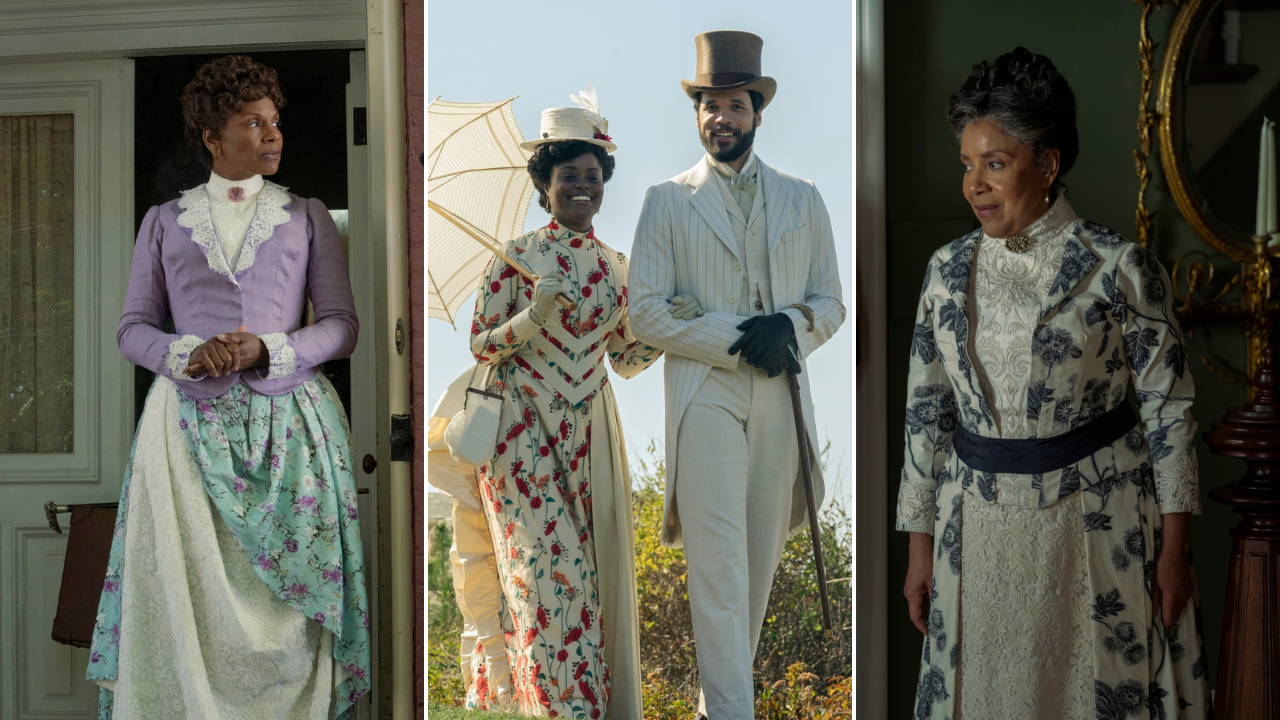
From Black high society to forbidden love, these books offer more stories like Peggy Scott’s in HBO’s “The Gilded Age.”
HBO’s “The Gilded Age” is back for season 4, pulling in nearly 4 million viewers for its premiere, and fans are once again caught up in the drama between the Scotts, Kirklands, van Rhijns, and Russells.
But one of the show’s most compelling storylines might be that of Peggy Scott, a Black aspiring writer and journalist, and her love story with Dr. William Kirkland. Spotlighting the wealth, ambition, education, and success some Black communities held during that time, the dynamics between the Scotts and the Kirklands quickly became a fan favorite. Now, if you need something to hold you over between episodes and “Parlor Talks” with Brittany Packnett Cunningham’s “Da Gild,” here are 8 historical fiction and nonfiction books that explore similar themes of Black wealth, love stories, liberation, and experiences in the 19th and 20th centuries.
Inspired by the real-life story of C.R. Patterson and his family, “The Davenports” series centers on one of the few Black wealthy families in the United States as their children find their way (and find love) even where they are not supposed to. Set in 1910 Chicago, the young adult series follows four determined young Black women working up the courage to steer their own paths in life and love
“The Gilded Years” offers a fictionalized account of Anita Hemmings’ experience as the first African American student to attend Vassar College, who did so by passing as white during the Gilded Age in 1897.
“Gilded Girls” follows four friends, Missy, Hazel, Poppy, and Countess, living in Washington, D.C. during the Gilded Age. While on a mission to prove themselves by staging the annual masquerade ball of the city’s leading ladies’ social organization, this YA (Young Adult) novel explores themes of love, coming of age, friendship, and belonging among D.C.’s Black bourgeoisie.
Described as the intersection between “Bridgerton” and “The Davenports,” this book centers a young Black woman trying to balance her independence with her future in 1860s London’s high society. Stella Sedgwick dreams of a writing career and independence, but when her late mother’s former employer announces plans to leave her a life-changing inheritance, the 18-year-old is forced to navigate the judgmental glares and unspoken rules of the upper class.
In her twenties, Belle da Costa Greene is hired by J. P. Morgan to curate a collection of rare manuscripts, books, and artwork for his newly built Pierpont Morgan Library. But Belle is keeping a secret: she is a Black American passing as white, and her real name is Belle Marion Greener. Based on a real woman, the novel follows the life’s work of Morgan’s personal librarian, who also became the first director of the Morgan Library & Museum
Libertie Sampson, a freeborn Black girl in Reconstruction-era Brooklyn, is pushed by her mother, a doctor, to follow in her footsteps. Then she meets Emmanuel Chase, a young Haitian doctor whose eager courtship and vision of Haiti as a Black utopia sweep her away. The novel is inspired in part by Dr. Susan Smith McKinney Steward, who in 1869 became the first Black female doctor in New York.
This nonfiction book dives into the rise and fall of the Black elite from Emancipation through Reconstruction to the Jim Crow era, using the life of Daniel Murray, an academic, entrepreneur, activist, and Black history pioneer, as a lens. Murray served as assistant librarian of the Library of Congress from 1881 to 1922, and was in the vanguard of Washington, D.C.’s Black upper class after the Civil War.
Before Harlem, there was Black Gotham. If you love Peggy Scott’s world on “The Gilded Age,” this is the real-life history behind it. Peterson set out to trace her own family tree, starting with a name and a family story about one great-grandfather that turned out not to be quite true. Digging through archives, she uncovered a whole community of elite Black New Yorkers in Lower Manhattan and Brooklyn who attended school, built businesses, organized national conventions, and led cosmopolitan lives. Part detective story and part social history, the book spotlights one of the many layers of Black Americans’ experiences in the 19th century.
More About:Lifestyle
Weekly New Episodes
Stream Now