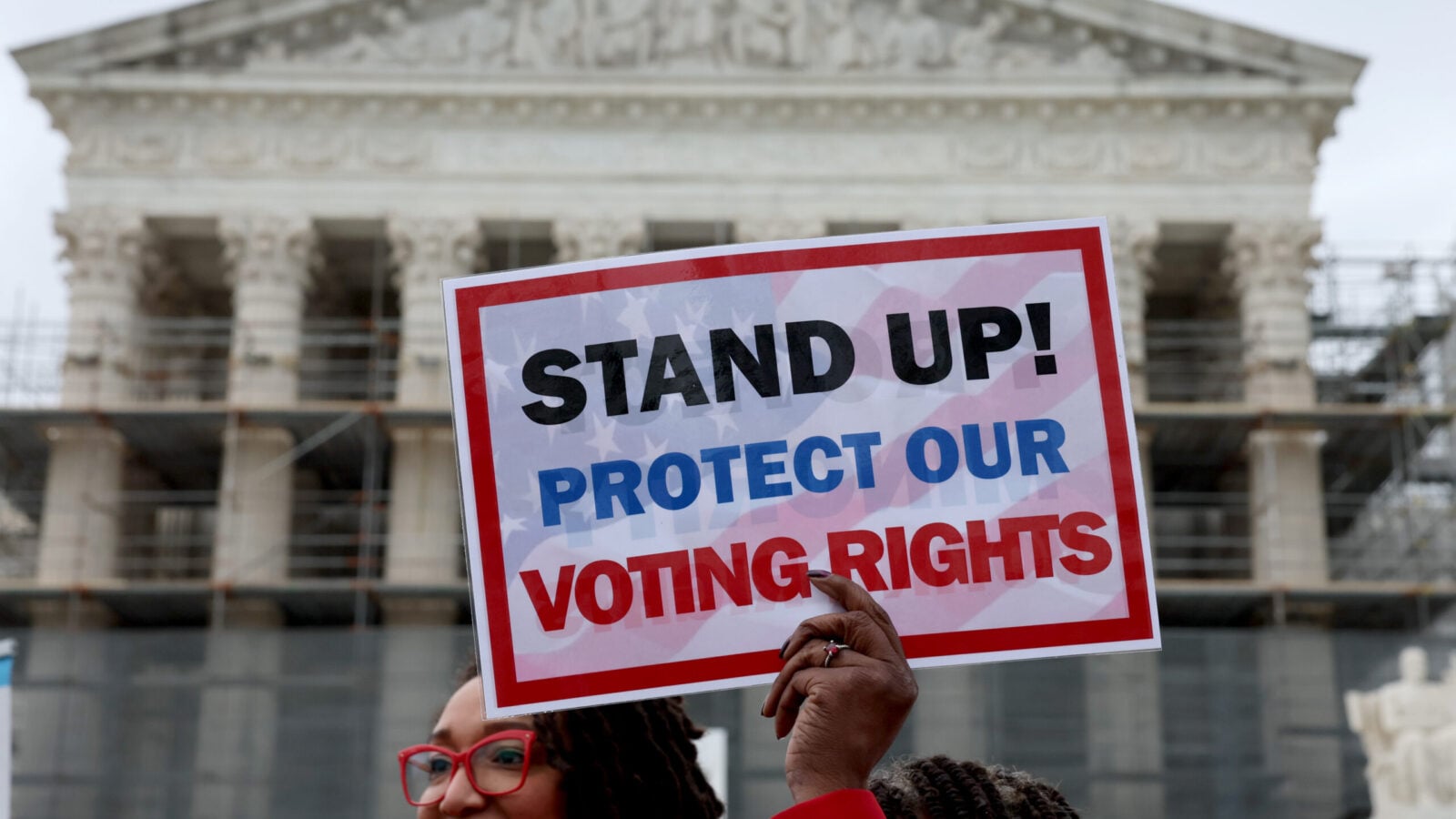
OPINION: New polling suggests voting rights and gerrymandering battles are increasing political engagement among Black voters ahead of the midterms.
Editor’s note: The following article is an op-ed, and the views expressed are the author’s own. Read more opinions on theGrio.
For the past several election cycles, I have been ringing the alarm to the Democratic Party about the erosion of engagement from Black voters. Many in the party didn’t want to hear the truth that Black voters were increasingly turning into swing voters – and that the old party model of just doing get-out-the-vote in the closing months of each election cycle was failing amidst Donald Trump’s aggressive outreach to Black voters on economic and cultural issues.
After the difficult 2024 cycle, the Party has increasingly realized that Black voters – especially younger voters and Black men – need to be treated as the new swing voters that they are. Since Barack Obama exited the political stage in 2012, Democratic Presidential candidates have seen an 11-point drop in support from Black voters, and a 16-point drop from Black men.
But, instead of welcoming Black voters into the tent – as suspected – Donald Trump’s administration has ignored their economic concerns while kicking them out of government positions and systematically dismantling programs that invest in Black communities. And, perhaps most significantly, Trump’s handpicked Supreme Court justices have undone protections of the Voting Rights Act in the greatest threat to Black political representation since Jim Crow.
The Callais v. Louisiana Supreme Court decision in April triggered a wave of blatantly racial gerrymandering in Southern states, and attempted to eliminate over a dozen Black congressional seats in the places where the majority of Black voters are concentrated. The South is not comprised of red states; they are oppressed states. But policies meant to ensure that the states with the highest Black populations continue to have the lowest Black turnout and representation were enough to activate Black voters across the South, and across the nation.
In fact, a new series of polls and focus groups by HIT Strategies and the Black Opps Coalition shows that the recent attacks on Black voting rights are producing a significant backlash. Recently, Black voters have heard the Supreme Court’s message loud and clear and they are more motivated to take action to defend their communities.
According to our research – part of a year-long project to look at Black political engagement – 64% of Black voters say recent attacks on voting rights and gerrymandering in the South make them more likely to vote in the upcoming midterm election. A youth-driven message focused on responding to Southern states’ attacks on Black voting rights increases Black voters’ likelihood to turn out by 7 percentage points – which would be a seismic shift in the electorate.
And Black political participation has risen as well, particularly during the discussion of gerrymandering over the past year. In October 2025, 62% of Black voters reported that they had taken three or more political actions such as voting, protesting or boycotting. In April, the number of voters willing to take these actions has risen to 75% – a 13 percentage point increase.
This movement comes because Black voters know that the dilution of Black political power – especially in the South – will weaken representation on real issues like schools, healthcare and public safety. And this attack on the policies that matter to Black voters has produced a backlash.
We know that resistance movements win elections. The 2020 Black Lives Matter movement mobilized younger voters of color and delivered Democratic victories in the general election. The 2020 abortion rights movement mobilized young people after the Dobbs decision and prevented a red wave in the midterm. In 2026, the resurgence of the voting rights movement after Callais has the power to once again deliver Democrats to victory in the midterms due to higher Black political engagement.
Now it’s up to community organizing groups and political candidates to deliver on this opportunity and make sure Black voters hear the right message loud and clear. That means talking about the attack on Black voting rights in terms that will reach the voters who are the most politically disengaged and rightfully cynical – especially younger voters and Black men.
Our research shows that a significant generational gap still persists. Black Generation Z voters are 31 percentage points less likely to “fight for American democracy” than Black voters from the Baby Boomer generation. Over half (56%) of Gen Z voters also believe that Black people have had mixed results from democracy, and do not believe it is their job to defend it; compared to 22% of Boomers.
This is a warning to our fellow Democrats and those who want to rebuild trust with Black voters: The same old messaging about American democracy is going to produce the same old results of disengaged younger voters. We cannot afford to throw away this moment of opportunity on more messaging that sounds like it comes from a political science textbook, instead of speaking directly to the frustration and cynicism that younger Black voters are feeling.
Based on our Black Opps research, we would recommend to our allies the following three steps to maximize Black political engagement in light of Callais.
First, stop talking about protecting American democracy, and start talking about protecting freedom and voting rights. Our research shows that 75% of Black voters believe it’s urgent to take action to defend “freedom,” while 71% say the same about voting rights. Just 63% believe it’s urgent to defend “American democracy,” including just 50% of Gen Z voters and 56% of Millennials. When we talk about broader Constitutional notions, we lose younger Black voters that we could mobilize with a more direct message about their rights and freedom.
Second, demonstrate the personal and economic impact of policies – and how attacks on voting rights are directly harming the lives of Black Americans. Our research shows that voters are more motivated when messengers connect the rollback of rights to policies like cuts to Medicaid, dismantling of food stamp programs and the rising costs of gas due to the Iran war.
Finally, community groups and political officials should start putting younger messengers front-and-center. In our research, we compared the impact of political engagement calls-to-action from a Black Boomer preacher and a Black Gen Z gamer. We found that the message from the Gen Z spokesperson was far more effective among Black voters of all ages. The Gen Z message increased the likelihood of voting by 7 percentage points, the likelihood of boycotting by 8 percentage points and the likelihood of participating in a voter registration drive by 11 percentage points. Younger and older voters alike want to see a future that engages all generations in defending the Black rights and freedoms that are currently under attack, and it’s time for us to lead with Gen Z voices.
The data are clear: Black voters are significantly more engaged in politics due to the recent attacks on Black voting rights. But, in order to seize this moment for change, we have to change the way we talk about the rights that are at stake. Callais is already producing a boomerang effect; now it’s on us to mobilize to make our voices heard across the country.
Terrance Woodbury is a political strategist, pollster and founder of HIT Strategies whose campaign experience helps turn data into actionable strategy. He has worked with organizations including the DNC, DSCC, Rockefeller Foundation and Gates Foundation. Under his leadership, HIT Strategies has grown from a small startup into a 30-plus-person firm and a leading resource for understanding and mobilizing key voting blocs. A sought-after political analyst, Woodbury’s insights have appeared in The Washington Post, POLITICO, The Wall Street Journal, NPR, CNN and MSNBC. A Morehouse College graduate, he is committed to amplifying underrepresented voices.
More About:Politics
Weekly New Episodes
Stream Now
The Supreme Court sent a message. Black voters are hearing it loud and clear

ByNews Videos
Aug 29, 2026