

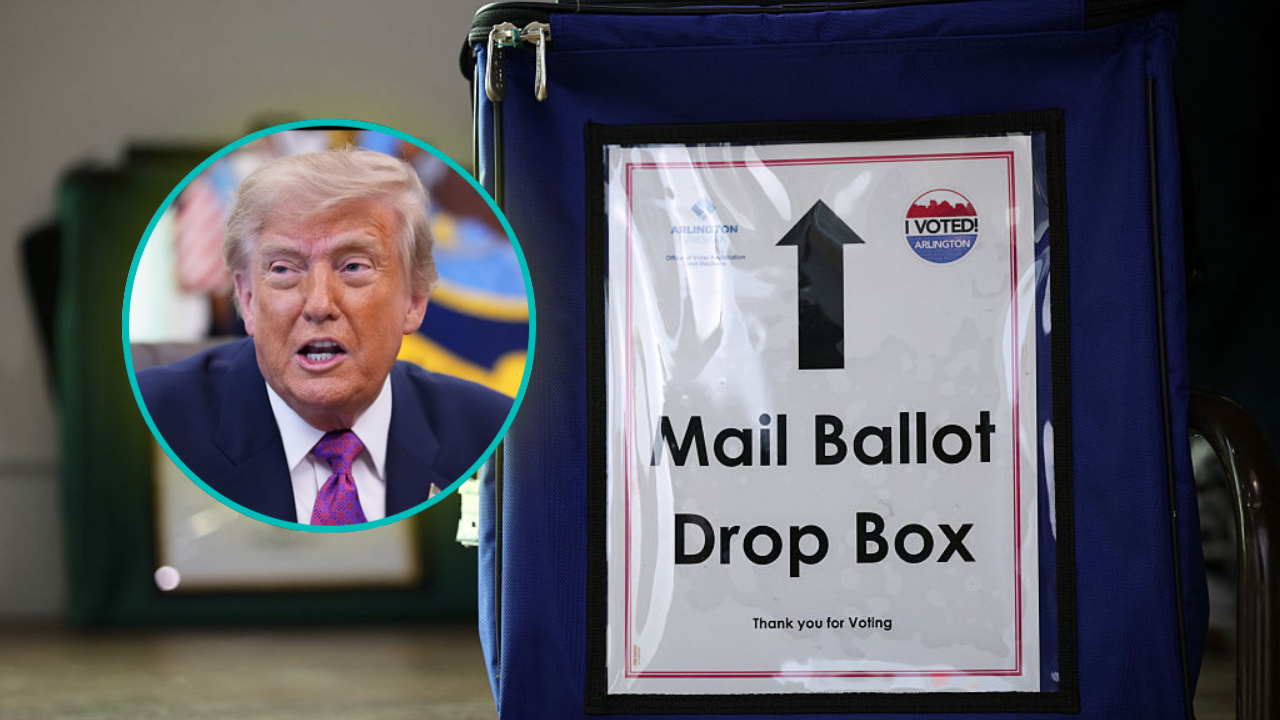
Voting rights groups warn the new USPS rules could disenfranchise millions of voters, particularly Black Americans, ahead of November’s elections.
As President Donald Trump appeals a recent federal court ruling that blocked his executive order that empowers the United States Postal Service to regulate and restrict mail-in voting, Black civil rights leaders say the president’s latest targeting of voting rights will not be successful on their watch.
“No federal entity should be allowed to implement last-minute rules that disenfranchise voters and override state election laws. This new USPS rule is a direct assault on the fundamental freedoms of millions of Americans—particularly Black voters,” says NAACP President and CEO Derrick Johnson. “We will not stand idly by while the voices of the people are silenced. We must protect every eligible citizen’s right to cast their ballot.”
Just two months before the Nov. 3 elections, the USPS, at the direction of President Trump, began implementing new rules on mail-in voting, including refusing to accept ballots that do not meet certain criteria outlined in Trump’s March order. The USPS is also refusing to deliver mail ballots unless states provide a list of voters who should receive them and format the envelopes in a certain way. Trump’s order also directs the U.S. Department of Homeland Security to create a “State Citizenship List” and transmit it to each state.
Twenty-four states and the District of Columbia, along with several civil rights groups, including the NAACP and Black Voters Matter, filed lawsuits challenging Trump’s order as unconstitutional. On Thursday, a federal judge blocked the implementation of Trump’s order on mail ballots, prompting the president to appeal to the U.S. Supreme Court. On Monday, the nation’s highest court ruled in favor of Trump, temporarily allowing his order to move forward — not on the basis that the order is legal, but on a legal technicality: the lawsuit was too premature because the administration had not yet implemented the new rules, the justices said.
Marc Morial, President and CEO of the National Urban League, tells theGrio that if the Supreme Court follows the law and the Constitution, “they will swiftly strike down this executive order.”
“The idea that a president by executive order can alter the constitutionally protected right of states to control the election processes ends the American Constitution in a way unimaginable,” said Morial. “The Constitution protects the right of the states, and if, in fact, there was going to be adjustments or changes to the voting system, it has to be done by act of Congress.”
The civil rights leader dismissed Trump’s premise for his restrictive mail-in voting order, telling theGrio, “There is no evidence whatsoever, not a scintilla, that demonstrates that there’s some sort of fraud that goes along with mail balloting. This is simply the president trying to alter the process in a way to try to rig the election in his favor.”
Trump’s job approval rating hit a record low amid rising costs and nationwide pushback of his anti-DEI and anti-immigration agenda. The White House is anticipating significant defeats for Republicans in the November elections. Trump has expressed concern that if Democrats win control of Congress, he will be impeached.
In an attempt to boost Republican victories, the president urged GOP-controlled states to redraw congressional maps, resulting in the elimination of majority-Black districts and the evaporation of Black representation in Washington. The Supreme Court’s April ruling in Louisiana v. Callais now makes it harder for Black voters to prove racial discrimination in these instances.
“We will not let this or any administration further undermine our democratic process,” said Damon Hewitt, president and executive director of the Lawyers’ Committee for Civil Rights Under Law. “We will fight to ensure our elections are free and fair, and that eligible voters are not shut out—especially Black voters and other voters of color, who are frequently targeted by voter suppression schemes.”
Cliff Albright and LaTosha Brown, co-founders of Black Voters Matter Fund, said leaders cannot “allow voter suppression to be repackaged as voter protection or allow political interference to determine who gets to participate and whose voice counts.”
The voting rights advocates added, “This is not about making democracy more secure; it is about reshaping who can fully participate in it. We will continue to call these efforts what they are and fight for every eligible voter’s freedom to make their voice heard.”
Hewitt said mail-in ballot restrictions threaten to “disenfranchise millions of eligible voters who rely on mail voting to participate in our democracy while balancing work, caregiving responsibilities, disabilities, and other realities of daily life.”
The civil rights attorney said the Trump administration is trying to “limit access to the ballot, sow confusion at the polls and to use the ensuing chaos as an excuse to exert power over agencies and processes in a politicized way.”
In addition to cracking down on mail-in voting, the Trump administration is reportedly preparing to deploy approximately 1,000 U.S. Department of Justice election monitors at voting precincts. Voting rights advocates have slammed the plan as an attempt to intimidate voters.
When asked about the possibility of Trump trying to overturn the November elections should he not like the outcome, as he did after losing the 2020 presidential election, Morial of the National Urban League told theGrio, “That would be tragic for America.”
“When he wins, there’s no problems with the elections. When he loses, the election system is problematic. People should see through this specious approach to disparaging those things that don’t work in [his] favor,” he said. “It’s nonsensical. It’s un-American, and that’s why we have to resist it.
More About:Politics
Weekly New Episodes
Stream Now