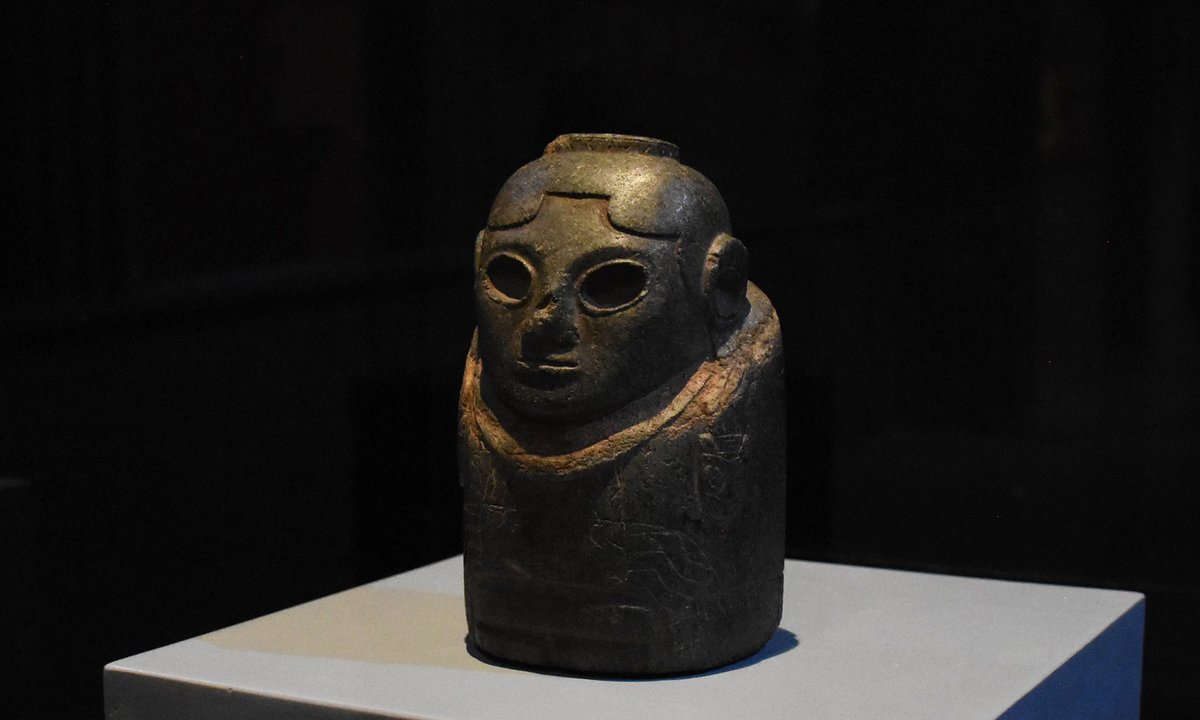
An Andean carving of a deity, known as an illa, that was repatriated to Bolivia from a Swiss museum in 2014 and is now on view at the Museo Nacional de Arqueología in La Paz Photo Courtesy Ruben Mamani
The Museo Nacional de Arqueología de Bolivia (Munarq), one of the country’s oldest museums, has reopened in La Paz after a year-long renovation. Its new permanent exhibition, Raíces eternas, legados vivos (Eternal Roots, Living Legacies), brings together 395 artefacts spanning more than 11,000 years. Highlights include Saphi, the mummy of a young girl repatriated from the United States in 2019, as well as an illa, an Andean stone figure stolen from Bolivia in 1858 and returned by a Swiss museum in 2014.
Organised into five thematic galleries and two chronological ones, the exhibition brings together archaeological objects dating from 10,000BC to the Inca period, around 1450. It chronicles the ways that the pre-Hispanic past continues in rituals and gestures that remain part of daily life.
“Many of our customs come from the pre-Hispanic era, which is why the exhibition is called Eternal Roots, Living Legacies. Because these practices are part of our daily lives and we do not always recognise them as legacies of the past,” Ruben Mamani—who oversees the museum’s archaeological and ethnological collections, and developed the exhibition’s new curatorial narrative—tells The Art Newspaper.
Installation view of Raíces eternas, legados vivos (Eternal Roots, Living Legacies) at the Museo Nacional de Arqueología de Bolivia in La Paz Courtesy Ruben Mamani
The objects on display represent only a fraction of the Munarq collection of more than 30,000 artefacts from across the country. Founded in 1838 and now housed in the Palacio Tiwanaku, the institution, which operates under the Ministerio de Turismo Sostenible, Culturas, Folklore y Gastronomía, recently adopted the slogan “Bolivia’s first museum”.
The exhibition’s “Immortality” section centres on Saphi, a mummified girl believed to have lived in the 15th century in the Pacajes region of what is now La Paz. Returned to Bolivia by the University of Michigan in 2019, the mummified body is now presented alongside its grave goods, including small shoes, bracelets and pouches containing coca leaves, potatoes, chuño, corn, beans and other foods. Saphi’s hair remains carefully braided. Rather than presenting the mummified remains as an archaeological curiosity, the exhibition emphasises Saphi’s individuality, “with all the respect she deserves as a human being and as a girl”, Mamani says.
“Saphi connects with a tradition that remains very present in Bolivia: Todos Santos (All Saints). We honour our ancestors and the dead by offering them food and drink,” Mamani says. “She was buried with many of the same elements that can still be found today on the family altars prepared for the celebration.”
Installation view of Raíces eternas, legados vivos (Eternal Roots, Living Legacies) at the Museo Nacional de Arqueología de Bolivia in La Paz, including the mummified remains of a girl, Saphi, which were repatriated by the University of Michigan in 2019 Courtesy Ruben Mamani
Mamani believes that Saphi may have been part of a Capacocha, an Inca ritual in which offerings were made at high-altitude sites. “She may have been offered to the deities to ask for a favour or protection,” he says. “Many people are moved when they see her. She has become an important part of La Paz’s collective imagination.”
A gallery titled “Vessels of Celebration” centres on qeros, ceremonial vessels made in matching pairs that became important at Tiwanaku and under the Inca. Sharing a libation was more than an act of drinking: it was a way of recognising the other person and forging an alliance.
A painting behind the qeros depicts the encounter between Atahualpa and the Spanish conquistadors at Cajamarca. The Inca offers a qero of chicha, which a Spaniard pours away, while the conquistadors present him with a Bible that he does not understand.
“These were two objects of enormous importance to two different cultures,” Mamani says. “For the Inca, the offering was a way to forge an alliance. For the Spaniards, the Bible embodied their faith. Their failure to understand each other marked a clash between two worlds and set the hostilities in motion.”
The exhibition also includes acullicadores, figures in ceramic and stone distinguished by a bulge in the right cheek. Acullicar means placing coca leaves between the cheek and teeth and leaving them there, a practice documented in the Andes since pre-Hispanic times. In La Paz, which sits around 11,800ft above sea level, coca is familiar to visitors as a traditional remedy for altitude sickness, but its significance is far broader. Mamani describes offering it as a gesture of hospitality: “When you arrive in a community, the first thing you do is offer coca. It’s a welcome.”
A display of historical ceramic vessels in Raíces eternas, legados vivos (Eternal Roots, Living Legacies) at the Museo Nacional de Arqueología de Bolivia in La Paz Courtesy Ruben Mamani
The final gallery features another of the museum’s most prized objects: a small black stone illa, a female figure linked to fertility and abundance. The sculpture also features amphibians and snakes, animals whose appearance in the fields is traditionally seen as a sign of rain and a good harvest.
By the mid-19th century, however, the illa figure had acquired another meaning. When the Swiss traveller Jakob von Tschudi encountered this particular illa in a house in Tiwanaku in 1858, he learned that residents worshipped it by lighting candles and believed it could recover stolen property, identify thieves or punish them. After its owner reportedly refused to sell it, Von Tschudi gave the villagers alcohol until they fell asleep. He then took the object and left Tiwanaku, later recording the episode in his own field journal.
“The irony is that the illa was known as the ‘Saint of Thieves’, yet Von Tschudi documented his own crime in his travel journal. That became the most important evidence in the repatriation process,” Mamani says.
The sculpture later passed to Von Tschudi’s descendants and was acquired by the Bernisches Historisches Museum in 1929. It remained there for 85 years before being returned to Bolivia in 2014. By then, it had become associated with the Ekeko, a plump male figure carrying goods who is central to Alasita, La Paz’s annual fair of miniature wishes. People buy tiny houses, cars, banknotes and even university diplomas, hoping to obtain them in real life.
The sculpture’s repatriation turned into a public pilgrimage. It was transported slowly from El Alto Airport in a glass case, while a crowd scattered flower petals and followed it for hours to Plaza Murillo. By then, people had begun calling it the “illa del Ekeko”. Mamani points out that the name contains a contradiction: the illa is female, while the traditional Ekeko of Alasita is male.
Museum will receive the buildings in former Olympic park for free, director says
Indigenous peoples valued luxury objects more as tools of statecraft and for communicating with the divine than for their precious metals
The dismissal of Michael Bennett, a curator at the Museum of Fine Arts in St Petersburg, came after colleagues at another institution raised flags about provenance gaps
Renovation of Bolivia's national archaeology museum gives repatriated treasures pride of place

ByNews Videos
Jul 21, 2026