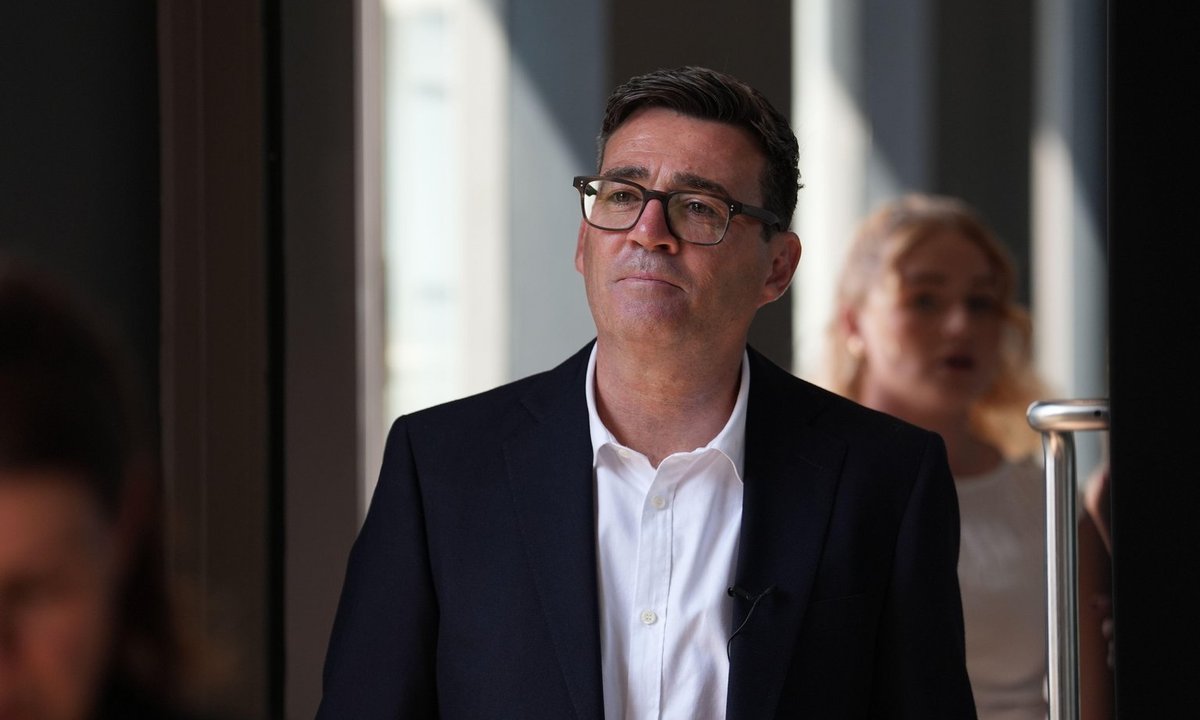
Andy Burnham’s cabinet is expected to be announced on 20 July
Photo: PA Images
Andy Burnham became the UK’s new prime minister today (20 July) and soon the public will learn who he has picked as his culture secretary. Whoever is in the role will face one of the most challenging briefs in Whitehall. From the future of Arts Council England and the funding of cultural assets, to artists' livelihoods, artificial intelligence and museum restitution, the department's in-tray is already overflowing.
Here are five of the biggest issues awaiting the new secretary of state.
With public finances under pressure, the arts sector will be looking for reassurance that the foundations of public cultural investment remain intact.
Maria Balshaw, the former director of Tate, tells The Art Newspaper that protecting free admission to national museums—a topic of intense debate in the culture sector recently—should be a priority. She argues that museums are one of Britain's greatest cultural assets and a major draw for international visitors, with four out of five overseas tourists citing them as a reason for coming to the UK.
Balshaw voiced her opposition to the idea of charging tourists to visit museums in England in March. She says: "UK museums are global cultural assets. Would we want to charge Nigerian visitors to see their Benin Bronzes at the British Museum, or Mexican tourists to see Mexican art, when their country has so generously lent to Tate Modern’s Frida Kahlo exhibition?"
She also dismissed the idea that philanthropy could replace public investment.
“Philanthropic giving is always complementary to the core public investment,” Balshaw says. Donors support ambitious exhibitions and public programmes because public funding already guarantees access, she argued, adding that sustained public investment remains the foundation on which private giving depends.
Balshaw, who recently became deputy chair of the University of the Arts London, also called for renewed support for arts education and to reinstate the Strategic Priorities Grant for creative courses. "Our art schools are the best in the world, and the numbers of foreign students coming to places like Central Saint Martins, the London School of Fashion or the Royal College tells us that the rest of the world recognises how valuable this kind of arts education is," she explains. "So the government should reverse the recent decision to stop the Strategic Priorities Grant for creative courses."
One of the new culture secretary’s first major decisions will be how to respond to the Labour peer Margaret Hodge's review of Arts Council England, which recommended greater devolution of arts funding and a rethinking of the organisation's role.
Few expect Arts Council England to disappear. The real question is whether it becomes less of a funding body and more of a strategic national agency.
Alison Cole, the director of the Cultural Policy Unit, which has close ties to Labour Party thinking, believes "greater devolution would inevitably reshape the role of Arts Council England, but it should not diminish it". Instead, she says that “rather than acting primarily as a direct distributor of funding, ACE could evolve into a more strategic national body”, setting standards and investing in projects of national significance while local decisions are taken closer to communities.
Cole argues that devolution should be accompanied by new local revenue streams, like a city tourism charge, and multi-year funding settlements to ensure it reduces, rather than redistributes, regional inequalities.
For the new culture secretary, responding to the Hodge review will be an early test of how far the Burnham government intends to devolve power beyond Westminster—and what role Arts Council England should play in that new settlement.
Restitution remains one of the most politically sensitive questions facing the UK's museums.
Tristram Hunt, the director of the Victoria and Albert Museum who was once in a Labour shadow cabinet with Andy Burnham, told The Art Newspaper that Burnham's government should revisit the National Heritage Act 1983, which restricts the V&A from deaccessioning objects apart from in very limited circumstances.
Hunt calls the act, which he has repeatedly said should be reviewed, “both outdated and infantilising for trustees of the national museums affected by it”. He says it prevents "necessary and much-needed de-accessioning of parts of the collection" and prevents museums from properly engaging with restitution claims. It allows institutions, he continues, to "hide behind the legislation rather than engage with detailed provenance research and consider legitimate applications for the return of looted goods."
He adds: "The 2022 charities act contained provisions for the ex gratia disposal of goods held by charities, and this could have applied to national museums with contested objects, but governments of both parties have thus far failed to apply the act in that manner."
Hunt believes next year's statutory review of the 2022 Charities Act provides an opportunity to consider extending ex gratia disposal provisions to national museums holding contested objects.
Burnham is already on the record as supporting the return of the Parthenon Marbles to Greece, a position that could signal a more open approach to such restitution questions under his premiership. The British Museum says it is prevented from returning the marbles by another piece of legislation, the British Museum Act 1963. The Art Newspaper contacted the Department of Media, Culture and Sport (DCMS) about whether Burnham stood by his remarks. The department responded: “Decisions relating to the care and management of the museum's collections, including loaning objects, are a matter for the trustees of the British Museum.”
There is the matter of looking out for artists, who face major and highly varied challenges to keep working in the industry.
Kate Oakley, a professor of cultural policy at the University of Glasgow, points to rising housing and studio rents, graduate debt, declining arts education and “a collapse in a lot of the income streams that artists would often have relied on to support their careers”.
She argues that there is no single policy capable of reversing those trends. Instead, improving arts education, tackling the cost of living and giving devolved authorities greater scope to support local cultural sectors could all make a difference.
Rather than introducing policies aimed solely at artists, like Basic Artists Income, Oakley favours broader reforms that make freelancing and insecure work more sustainable across the economy.
She says: “Making freelancing more sustainable—through changes to the tax system, a more flexible benefits systems or social insurance systems for freelancers such as those found in some European countries—could possibly help all precarious or freelance workers and I think that is more politically defensible.”
Artificial intelligence has rapidly become one of the defining issues facing the creative industries, with ministers under growing pressure to balance innovation with artists' rights.
Christian Zimmermann, the chief executive of the Design and Artists Copyright Society (DACS), says the government's priority should be straightforward.
"Artists must have a say when their work is used for AI, and they must be paid fairly," he says. "AI has real potential, but it cannot be built on the unauthorised use of visual artists' and creators' work."
Zimmermann argues that the UK's copyright laws are broadly fit for purpose but enforcement is lagging behind.
“It is not the copyright law that is the problem but the ability to enforce it and the behaviour of big tech that disregard existing rules,” he says. He says stronger enforcement, greater transparency and practical licensing arrangements that ensure creators share in the value AI generates are all needed.
Taken together, these issues underline the scale of the task awaiting . The new Culture Secretary will have little time to settle into the role before making decisions that could shape the country's cultural landscape for years to come.
Lisa Nandy's apparent support for repatriation reform has been welcomed by the head of London's Victoria and Albert Museum
New report says a more restrictive migration system for EU citizens “could threaten the international status of the UK’s world-class institutions”
The UK prime-minister-in-waiting’s legacy is seen as not just about big-hitter projects such as Factory International but also the way culture has been threaded into the city’s infrastructure
As Andy Burnham becomes the new UK prime minister, here are five key challenges facing his culture ministry

ByNews Videos
Jul 20, 2026