

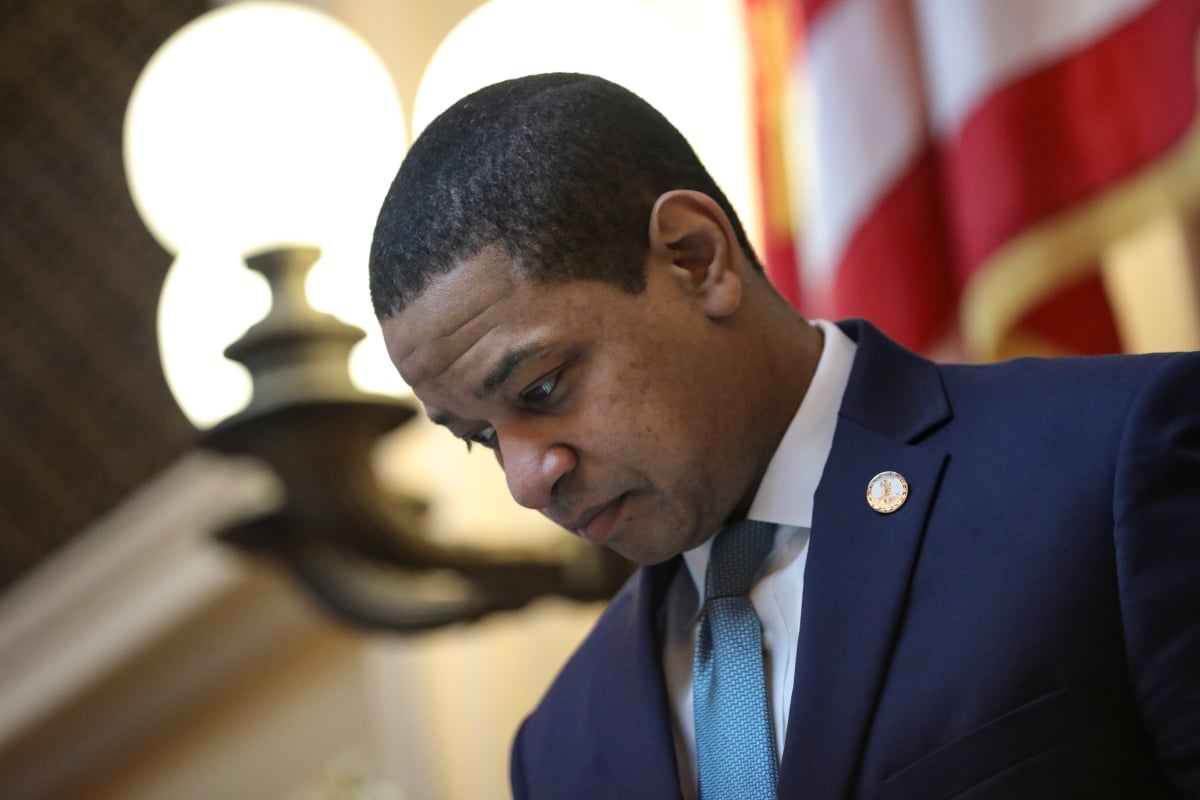
Former Lt. Governor of Virginia Justin Fairfax shot and killed his wife, Dr. Cerina Wanzer Fairfax, and himself on Thursday.
Editor’s note: The following article is an op-ed, and the views expressed are the author’s own. Read more opinions on theGrio.
In the early hours of Thursday, April 15, Virginia’s former lieutenant governor, Justin Fairfax, shot and killed his wife of 19 years, Dr. Cerina Wanzer Fairfax, in their home before turning the gun on himself. By noon, the 47-year-old disgraced politician was being eulogized like a saint by several people who once knew him.
Several posts addressed him as a “dear brother,” while in others, he was described as “smart,” “thoughtful,” and even as a “gracious individual.” It didn’t take long for outrage to follow.
As many Black women have since taken to their platforms to call out those early reactions, underneath that outrage lurks a real feeling of disappointment because, as disturbing as the response is, it isn’t new.
Again and again, with men who have caused real harm, often to Black women, society rushes in to protect their humanity instead of acknowledging the harm they have caused. We’ve seen this with figures like Chris Brown, R. Kelly, Dr. Dre, Russell Simmons, Floyd Mayweather Jr., Eric Adams, and others. However, those character references don’t clarify what happened — they just complicate the narrative and risk reshaping how the violence is understood.
In the hours after the news broke, initial framing from authorities said it was “a domestic situation” tied to a “messy” divorce, inadvertently placing blame beyond the scope of a man who chose violence. Meanwhile, multiple fraternity brothers of his, including commentator Roland Martin, who came to his defense, went so far as to imply it was because of his mental health and not society’s penchant for violence against Black women. Then there’s fellow politicians like former Republican delegate Tim Anderson, who have even begun revisiting his past allegations of sexual assault and the way those claims arrived, as he was gaining political traction, effectively derailed his political future.
In 2019, as he was still serving as Virginia’s Lt. governor, he faced sexual assault allegations from one woman who claimed the assault occurred while they were both students at Duke in 2000, and another who claimed it occurred in 2004 while they were at the Democratic National Convention. There were calls for him to resign, which he refused, and instead pushed back hard, denying the allegations and calling for a full criminal investigation. He finished out his term and ran for Governor in 2021, but lost to Terry McAuliffe.
It’s as though, for some, the real tragedy is that a Black man, who may have had the potential to be president, got caught up in allegations, and not that his story ends in this violent tragedy at his own hands. What’s getting lost, however, is Cerina. A woman who lost her life at the hands of someone who once promised to love her. A woman who had been a dentist with her own practice, a mother of two, a thriving member of the community, a friend, and a daughter.
Black women have long said they do not feel protected—not by institutions, not by society, and often not by Black men. The response to this moment that arrives as Black women remain the most vulnerable to intimate partner violence and femicide, and amid a tragic few weeks in which multiple Black women have been killed or died under mysterious circumstances at the hands of their loved ones, including Ashlee Jenae, who was found dead while on vacation with her fiancé; Coral Springs, Fl., Vice Mayor Nancy Metayer, who was killed by her husband earlier this month; and Davonta Curtis, a transwoman in Chicago who was murdered and robbed by a romantic partner, only works to prove why.
More About:Lifestyle
Weekly New Episodes
Stream Now