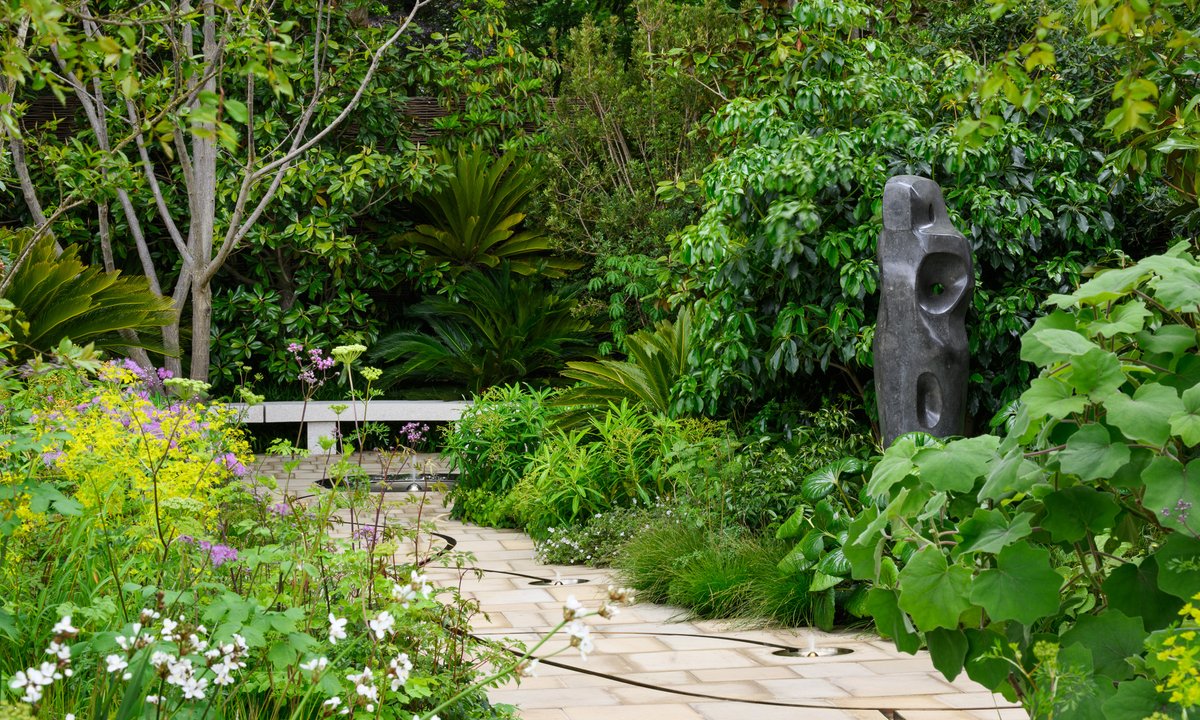
The Tate Britain Garden at RHS Chelsea Flower Show 2026 featuring Barbara Hepworth's Bicentric Form (1949)
Photo: Jason Ingram
Visitors to the Royal Horticultural Society (RHS) Chelsea Flower Show in west London can get a sneak preview of Tate Britain’s new garden which will feature key sculptures from the collection.
The Tate Britain Garden offers “a taster of the forthcoming Clore Garden at Tate Britain”, designed by Tom Stuart-Smith and scheduled for completion in 2027. After the show, the garden will be transferred to Tate Britain on Millbank.
At the heart of the RHS Chelsea garden is Bicentric Form, a 1949 sculpture by Barbara Hepworth that was the first work Tate acquired by the artist. “Hepworth was very progressive in showing her work in a garden context and we are using very bold textures and forms as a counterpoint to the dark, smooth stone of the sculpture. I think she would approve,” says Stuart-Smith in a statement.
Tate Britain director Alex Farquharson tells The Art Newspaper that the “sculptures [featured in the final garden] will go from classic modern to contemporary; they will be [located] there for years and years. In each case, there will be this beautiful dialogue with planting. The whole garden will reframe the building.” He says that the museum's Millbank entrance will close shortly.
“Previewing plant species that will be seen in the Clore Garden, The Tate Britain Garden showcases planting that thrives in central London’s now virtually frost-free environment and rising temperatures, such as Mediterranean fig trees and foliage like Schefflera shweliensis, native to the Eastern Himalayas,” says a Tate statement. A wildlife pond also forms part of the design.
Installation of Barbara Hepworth’s limestone sculpture, the first work from the national collection to be exhibited in a garden at the RHS Chelsea Flower Show
©Tate Photography (Sonal Bakrania)
Recycled elements are a prominent feature. Existing stone from the Millbank site has been cut and repurposed as paving while a central bench is cast from reused materials, including the paving from Tate Britain and locally sourced cockleshells from the Thames Estuary.
Roland Rudd, the Tate’s chair of trustees, told The Times last year that the new garden will be transformative. “At the moment, let’s be honest, when you go to Tate Britain it is awful,” Rudd said. “You have got these rows of bushes [at the front] and they look very old, they look manky. People tend to relieve themselves behind them.” Farquharson says on the forthcoming changes: “We’re absorbing the taxi rank but you’ll still be able to be dropped off… the taxis will all move to the side. There will be a section of the garden in front of the steps.”
The Tate Britain garden at Chelsea is funded by the Clore Duffield Foundation and Project Giving Back, the grant-giving charity that funds gardens for good causes (the Clore Garden on Millbank is backed by the Clore Duffield Foundation and the Julia Rausing Trust). In the meantime, the museum will open Living Gardens, a year-long free display from 15 June, that will bring together works inspired by horticulture, featuring artists such as Derek Jarman and Christine Kühlenthal.
The galleries are set to reopen in May after funding goals were reached
Stephen Deuchar, director of the Tate Britain, talks about the new thematic displays and future major survey shows of New British art, Blake and Spencer
Scholar with an international outlook who was director of the Henry Moore Foundation and executor of his mother-in-law, Barbara Hepworth
British artist Hew Locke has been selected for Tate Britain’s Duveen Galleries commission, while Barbara Hepworth gets a survey at Tate St Ives