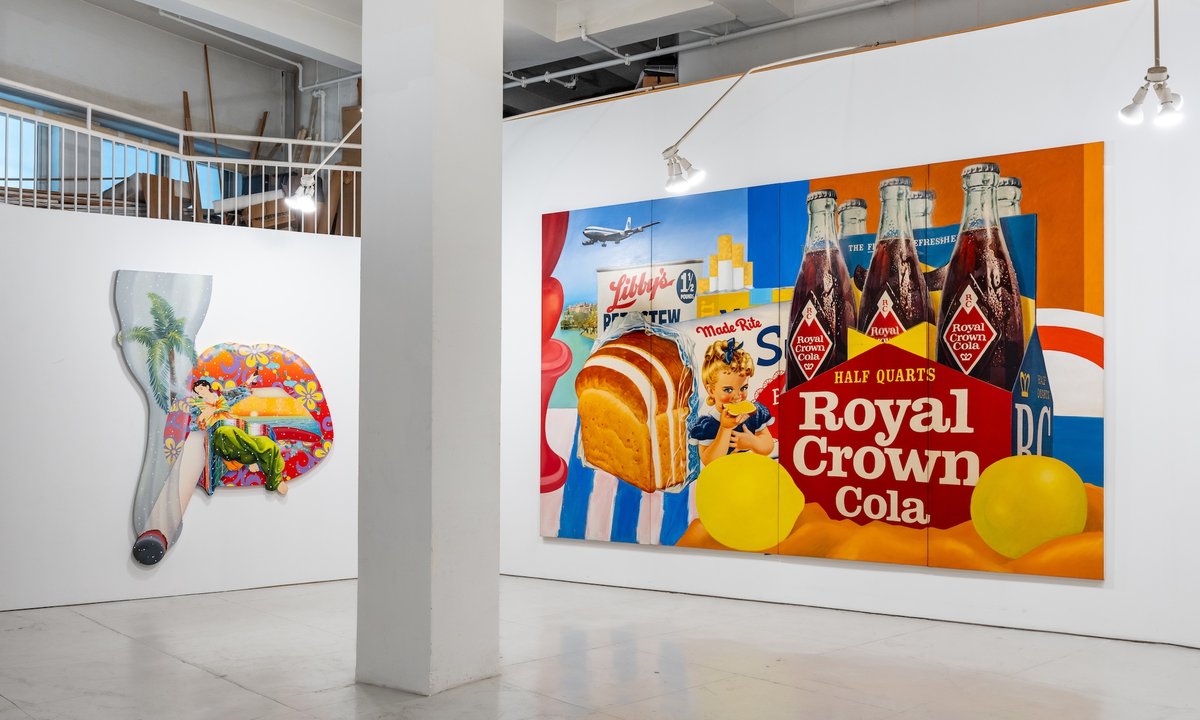
Installation view of Wesselmann x Matsuyama, featuring Tomokazu Matsuyama's Smoke On The Water (2026, left) and Tom Wesselmann's Still Life #35 (1963, right)
Courtesy of the Tom Wesselmann Estate
A lucky few will get to visit the late great Tom Wesselmann’s former studio in Cooper Square this month for an invite-only exhibition pairing the Pop Art pioneer’s work with that of the Japanese American contemporary artist Tomokazu Matsuyama. The exhibition, Wesselmann x Matsuyama (until 30 September), was organised by Wesselmann’s estate with support from Almine Rech and highlights both artists’ penchant for bold palettes, maximalist compositions and incorporating mass-produced imagery from advertising to packaging design. It builds on a previous juxtaposition of their work in Pop Forever Tom Wesselmann &…, a 2024-25 exhibition at the Fondation Louis Vuitton in Paris.
For this show, staged in the space where Wesselmann made most of his work between 1994 and his death in 2004, the Pop artist’s estate has paired seven of his works with five pieces by Matsuyama. They include Wesselmann's billboard-sized, four-canvas painting with collaged elements, Still Life #35 (1963), and Matsuyama’s similarly monumental We The People (2025). Wesselmann’s composition, a post-war American riff on classical still-lifes, depicts a table set with branded foods and drinks including Made Rite bread and Royal Crown Cola. Matsuyama’s cinematic composition, meanwhile, could depict the grocery shopping session that preceded Wesselmann’s consumerist spread: a dozen figures whose poses allude to classic paintings by Jacques-Louis David are seen exploring the offerings in a supermarket’s breakfast and pharmacy aisles, eyeing packages of Chex cereal, Mucinex cough medicine and more.
A retrospective opening at the Montreal Museum of Fine Arts gives overdue attention to the work of the Venezuelan American who graced fashion magazine covers in the 1960s before fading away from the limelight
Thaddaeus Ropac gallery will recreate a 1967 work by the American artist Sturtevant, which near-copied Oldenburg's 1961 installation as a comment on authorship and originality
Show will 'explore the artist's spiritual side' with Last Supper series and skull silkscreens