

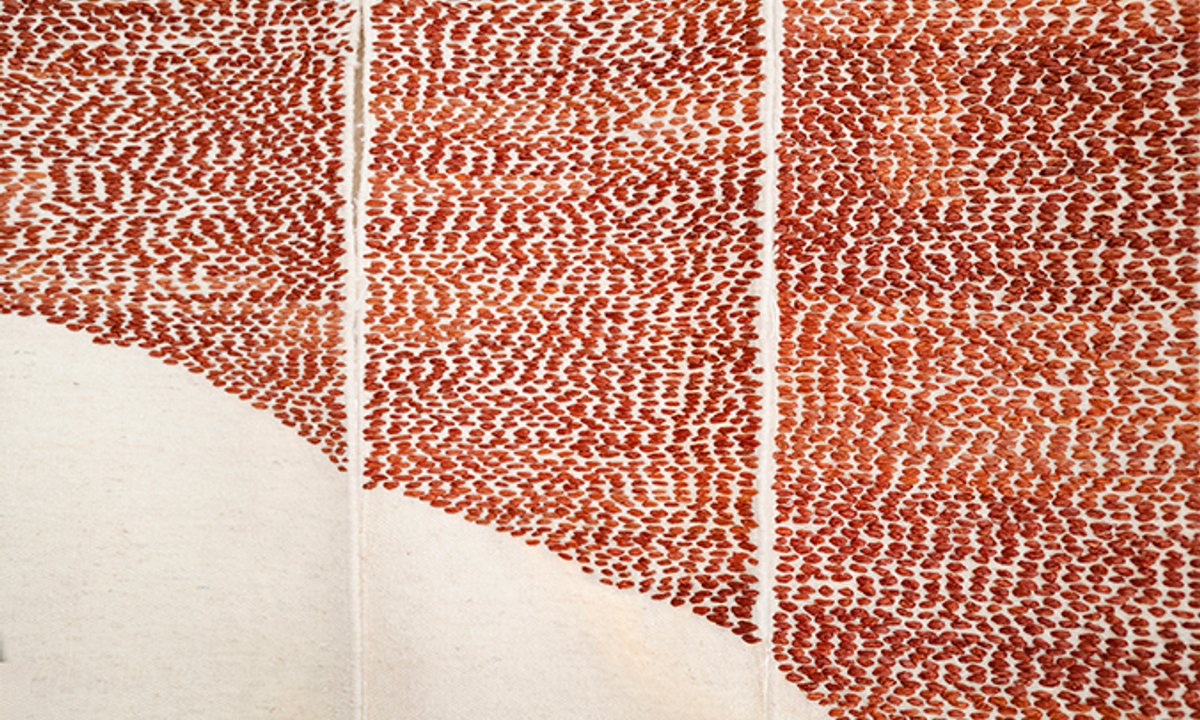
Detail from raffia embroidery, produced by the artisan Malika Benmoumen in Casablanca
Photo © Ayoub El Bardii, courtesy Moroccan Ministry of Youth, Culture and Communication
For its first national pavilion at the Venice Biennale, Morocco is building on its centuries-old tradition of craft. Titled Asetta, which means “loom” and “ritual of weaving” in the Amazigh language, the monumental 300 sq. m installation by the Moroccan artist Amina Agueznay is a site-specific work designed for the Arsenale.
Aqueznay conducted extensive field research across Morocco and worked with a team of more than 130 artisans, including weavers, beadworkers and embroiderers, the majority of whom were women, some of whom the artist has been working with for decades. The materials and work moved from Casablanca to Marrakech and from Souss-Massa in southern Morocco to the middle of the Atlas Mountains, close to Rabat.
The resulting installation is billed as an exploration of the transmission of Morocco’s traditional craftsmanship and shared memory. It also seeks to honour the land and people who shape and sustain the country’s artisanal traditions, resonating with Koyo Kouoh’s theme for this Biennale, In Minor Keys.
“Transmission, the way I see it, is between the artisans and myself. The curator [Meriem Berrada] and I are passing intangible stories between us. And then we are transmitting to the people who will be experiencing this immersive installation,” Agueznay says.
The installation by the artist, who is also a trained architect, examines the concept of the threshold, or âatba, described as the passage between inside and outside, private and public, sacred and profane, which is vital to Moroccan vernacular architecture. There is also a “functional aspect” of the installation for viewers who might be a little more curious or just want to rest; the design of the installation allows people to sit and take in the work.
“I hope that when a visitor gets into [the installation] the energy that transpires through the work will be communicated,” Agueznay adds. “That’s my goal as an artist.”
Sales highlights from the VIP preview include a major Amoako Boafo acquisition and works by leading Moroccan artists
Appeal brings artists and institutions together to raise funds to support survivors and long-term reconstruction
The Moroccan cultural sector has been hard at work to help the communities hit hardest by the disaster and trying to remind people that "this is still going on"
Museum of African Contemporary Art Al Maaden will hold “international opening” in February