

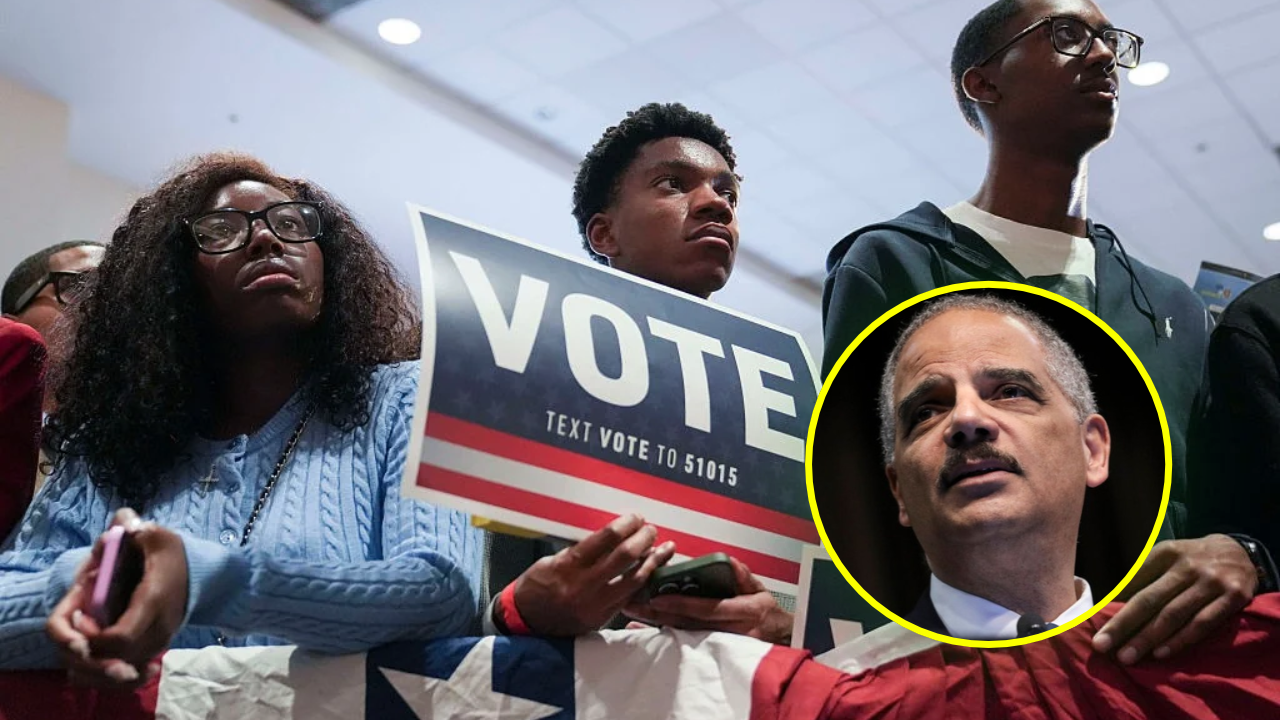
The former U.S. attorney general says Republican-led redistricting is weakening Black political power and urges voters to push back at the ballot box in the midterms.
Former U.S. Attorney General Eric Holder wants Black voters to know that the fight for fair election maps and Black representation is far from over, and they have the chance to do something about it just days before the midterm elections next Tuesday.
“I don’t wanna hear this nonsense about ‘My vote doesn’t count,’” said Holder, who was the first African-American to lead the U.S. Department of Justice under President Barack Obama. “Really? If you think your vote doesn’t count, well, if it didn’t count, why do you think Republicans are going to such great lengths to make it more difficult for you to vote? To make it so that your vote counts less through gerrymandering, through all the things that they’re trying to do to dilute Black power?”
Holder, who is now the chairman of the National Democratic Redistricting Committee, has been traveling around the country to inform Black voters about the threats posed by the racial gerrymandering of election maps and encouraging them to fight back with their votes on Nov. 3.
“If your political power gets diminished, well, suddenly you’re not getting as much money for your schools. You’re not getting as much public safety money. It [has] an impact on people’s lives day-to-day,” said Holder, who in recent days traveled to Texas, Georgia, North Carolina, Michigan, and Ohio, as part of NDRC’s work this election cycle to educate voters about partisan gerrymandering, which is primarily impacting Black communities.
Holder founded the National Democratic Redistricting Committee in 2017, with the help of President Obama and former U.S. Speaker Nancy Pelosi, to fight back against the increase in partisan gerrymandering undertaken by Republican-controlled legislatures in the aftermath of the 2010 U.S. Census, which some saw as a backlash to Barack Obama’s historic election as America’s first Black president.
“It was not something that was on people’s consciousness, certainly when we formed…people were kind of like, ‘Well, what’s gerrymandering?’” Holder recalled. “That all changed after people’s consciousness had been raised as they saw their political power being diminished, and then seeing what that meant.”
The issue of partisan redistricting reached new proportions following President Donald Trump‘s return to the White House. In 2025, Trump issued an unprecedented call for Republicans in Texas to redraw their congressional maps to net the party five additional seats. In order to do that, Republican state lawmakers diluted majority-Black and brown districts.
Then, in April, the U.S. Supreme Court struck down a second Black-majority district in Louisiana in the case Louisiana v. Callais, despite having previously allowed its creation years earlier. The conservative majority of the high court ruled that the Black opportunity district was racially discriminatory against the plaintiffs, a group of white voters. In doing so, the court weakened Section 2 of the Voting Rights Act of 1965, making it more difficult for Black voters to bring successful cases of racial discrimination in voting.
Soon after the elimination of Louisiana’s second Black district, several states—Tennessee, Alabama, North Carolina, Ohio, and Florida—moved to eliminate or diminish the influence of Black voters, particularly in districts where they made up a majority of the population. That includes Tennessee’s once-majority 9th Congressional District, where State Rep. Justin J. Pearson is running as the Democratic nominee in a closely watched post-Callais contest.
“It’s consistent with what they’ve been doing over the course of the last decade,” said Holder. However, the former U.S. attorney general says that based on early voting patterns and conversations he’s having with Black voters, particularly in the U.S. South, he anticipates a Black-lash to Republican gerrymandering next week.
“I think African Americans understand what the Republican power structure has been trying to do to them,” he explained. “This whole effort on their part is going to fail.”
In congressional races like U.S. Rep. Shomari Figures’ re-election bid in Alabama’s 2nd Congressional District, Holder says it will be a “fight” but “not impossible” for Black and other Democratic voters to overcome.
There are also signs of political weakness for Republicans, given the unpopularity of Trump’s second presidency. In Texas, for example, Trump’s loss of support among Latino voters as a result of his immigration policies poses a risk to Republican control in the state legislature, U.S. Senate, and the governorship. The BBC reports that Texas accounted for one-third of all ICE arrests nationwide in July 2026, the largest share of any state.
Holder tells theGrio that if Democratic nominee James Talarico wins the U.S. Senate or Democratic gubernatorial nominee Gina Hinojosa wins the governor’s race, it would “reverberate beyond the borders of Texas.” He added, “And the same thing will be true if Keisha [Lance Bottoms] wins [the governor’s race] in Georgia, and if [Scott] Colom wins [the U.S. Senate race] in Mississippi.”
The former DOJ chief continued, “That shows that a coalition of African Americans, progressive and concerned whites, and Latinos has political power, the likes of which Republicans have never had to confront before. That power does exist. It’s just that we have not used that power.”
Holder knows from experience that there’s value in fighting back. After the Supreme Court’s Callais decision, he and the NDRC filed successful lawsuits in Utah and Missouri to block their gerrymandered maps. The organization also lobbied Republican lawmakers in states like Georgia and South Carolina, where they ultimately decided against redistricting this election cycle.
“[We explained] if they did what Trump asked them to do, that it was gonna be a political consequence for them,” said Holder, who said Black voters especially have a stake in pushing back.
“The fight against DEI, all the ways in which they’re trying to diminish Black political power. The way in which they have turned their backs on environmental justice,” he told theGrio. “This administration, and Republicans more generally, have not only tried to turn their back on Black folks, they wanna take Black people in this country back 50, 75 years.”
He added, “When Trump says, ‘I wanna make America great again,’ he’s talking about the mid-1950s before the Civil Rights Movement. That’s when he thinks America was great, and we can’t allow that to happen.”
More About:Elections
Weekly New Episodes
Stream Now