As white creators claim to “code switch” on social media, they’re revealing just how little they understand about why it exists.
Another day, another social media debate. This week, corners of the internet have been debating the practice of code-switching, a term that dates back to 1954. The discourse was sparked by a number of videos from white creators calling out how they code-switch at work. And naturally, these comments have Black social media users doing a double-take.
One of the main videos social medis users have been referencing is of a white user advising people to code switch in the work place to “level up.”
Now there are quite a few layers behind why social media users are so upset, but let’s start with the basic question: What is code-switching?
Merriam-Webster dictionary defines the term as “the act or practice of changing one’s speech, behavior, etc. to suit different social or cultural contexts,” or “a switching from the linguistic system of one language or dialect to that of another (as for different social or cultural contexts).” In the 1950s, Einar Haugen and Uriel Weinreich laid the groundwork for modern studies of code-switching by focusing on bilingual people switching between languages. However, through the years this notion has expanded beyond linguistics and become a part of sociologists’ studies, particularly when studying its occurrence between ethnic groups. In “Language and Interracial Communication in the United States: Speaking in Black and White,” George B. Ray describes code-switching as “a skill that holds benefits in relation to the way success is often measured in institutional and professional settings” for Black communities.
Or as the Oxford Review defines it, codeswitching is “ the practice of shifting between different languages, dialects, or speech styles depending on the social context, audience, or situation. It often involves adapting one’s communication style to fit in with different cultural, professional, or social environments.”
So what’s the problem?
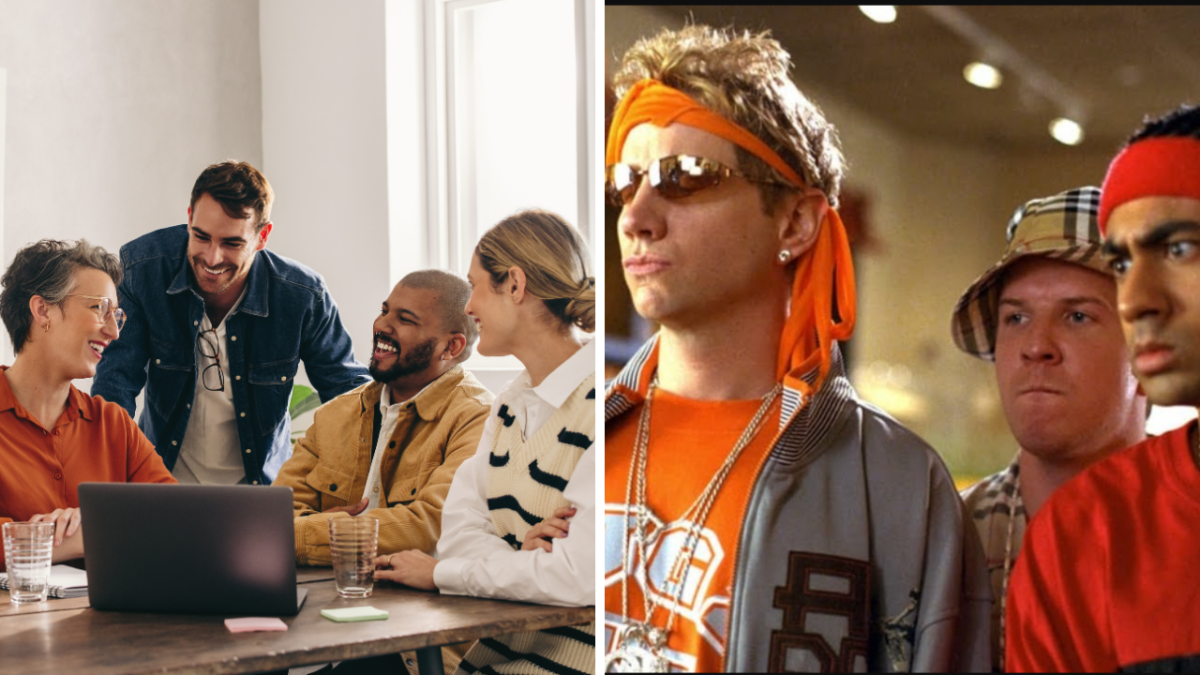
Much of the discourse has hinged on one question: is code-switching an exclusively Black practice? Some users are pointing to the dictionary definition to argue that yes, white people can code-switch too. But that misses the real issue. When these creators describe their own code-switching, especially the ones in the videos that kicked this all off, what they’re actually describing is switching out of AAVE (African American Vernacular English) and into more “proper” English. Think B-Rad from “Malibu’s Most Wanted.”
And that’s where the discussion becomes particularly frustrating. It goes back to the idea that everyone “wants to be Black” without the harsh realities that come with being Black in a world filled with systems built against you. For years, Black communities have watched other races and communities adopt elements of Black culture (vernacular, style, beauty trends, dances, music) and claim it as their own without giving proper credit or acknowledgment to the communities that created them.
And oftentimes these things, though eventually becoming cool, are created out of necessity or are long-term consequences of the oppression Black communities faced for decades in the US. And code-switching is one of those tools that Black communities were forced to learn, and continue to use, as a means of survival in predominantly white spaces.
Because no matter how much we’ve evolved, racism still sits at the foundation of society and certain societal norms. And as a means of survival, Black communities were forced to change their dialect to be perceived as more “appeasable,” thus code switching. And while the term specifically focuses on linguistics, those changes extend far beyond words and include changing hairstyles, fashion choices, etc.
At the end of the day, code-switching is not some secret career hack; for Black communities, it has served as a means of survival in a world that tries to vilify everything and anything we do or say.
More About:Lifestyle
Weekly New Episodes
Stream Now