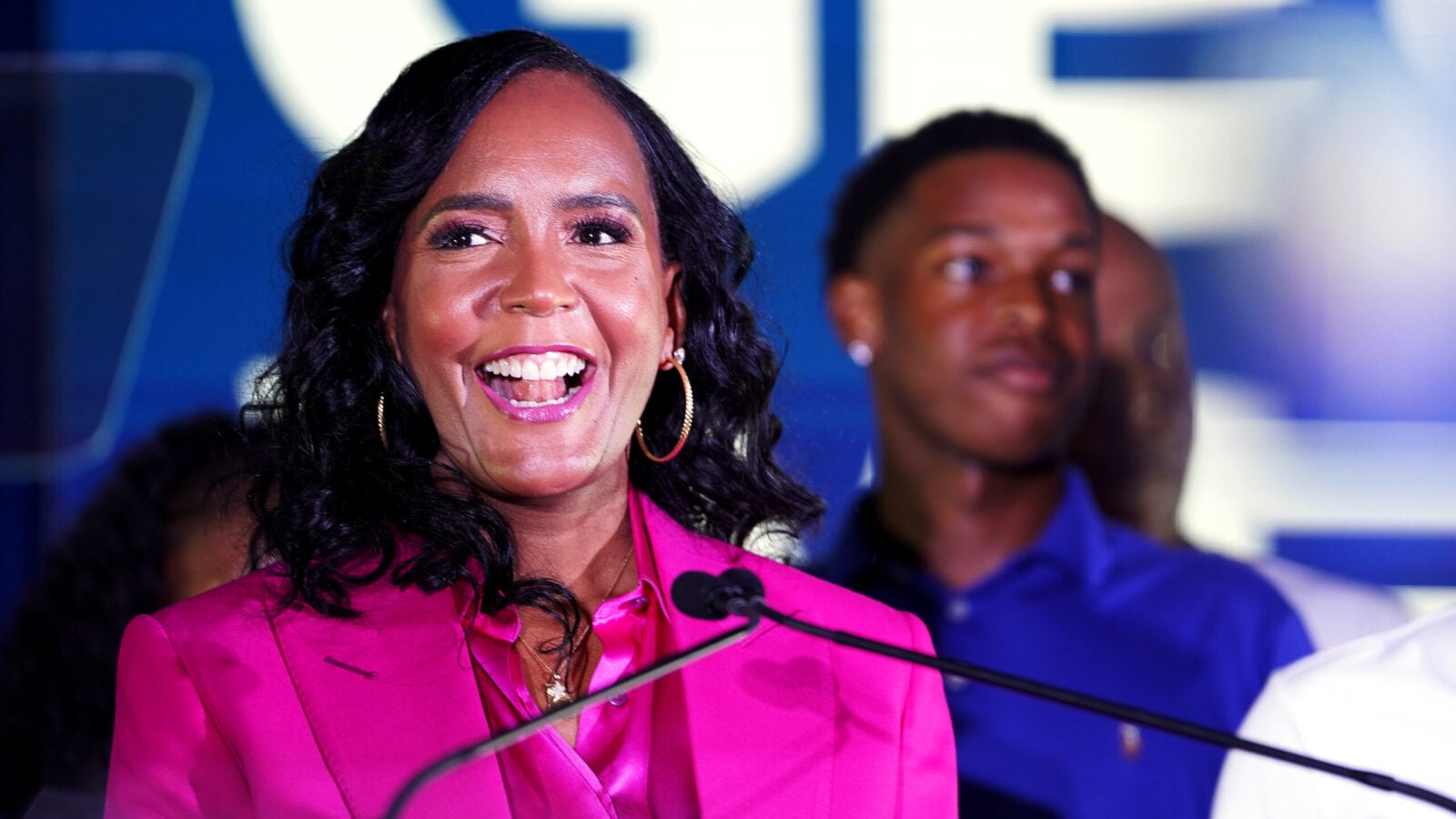
After 72 Black women were on the ballot and a blue wave that included historic wins, Black women’s political power is gaining.
Before anyone even cast a ballot on Election Day this year, Black women had already made history.
On Tuesday, Nov. 3, during the 2026 Midterms, there was a remarkable number of Black women on the ballot in races across the country. 72 to be exact—four U.S. Senate nominees, 40 House nominees, two gubernatorial candidates, and 26 women vying for other statewide offices.
According to data by the Higher Heights Leadership Fund and Rutgers University’s Center for American Women and Politics, 114 Black women in total sought House seats, up from 88 in 2024, while another 13 pursued Senate seats, up from 11.
“From the possibility of three or more Black women serving together in the United States Senate to the opportunity to elect our nation’s first Black woman governor, these races represent the continued expansion of Black women’s political power,” Glynda C. Carr, President and CEO of Higher Heights Leadership Fund, said in a release.
The historic showing has arrived alongside a massive blue wave in which Democrats have reclaimed both chambers of Congress, with Black women voters helping to deliver many of these wins. The 2026 Midterms have also ushered in a slew of historic victories for Black women candidates, including former Atlanta Mayor Keisha Lance Bottoms, who became the first Black woman elected governor of a U.S. state. And while some of the most closely watched candidates fell short, this election cycle has still offered plenty of indication we are experiencing the literal changing face of American politics.
On election night, Bottoms managed to defeat Republican Rick Jackson, ending more than two decades of Republican control of the governor’s mansion.
“Georgia, this win is for all of us. I will be a governor for all of Georgia,” Bottoms said in her victory speech. “We sent a message loud and clear that we want a leader who will put Georgia first and who will stand up to all the chaos coming out of Washington, D.C. But even more importantly, you sent the message that in these times of division and acrimony, you believe in something foundational, and that is hope.”
Meanwhile, over in the U.S. Virgin Islands, former longtime congressional delegate Stacey Plaskett became the first woman elected governor of the territory. And the wins just kept coming.
In Illinois, Lt. Gov. Juliana Stratton won her bid for the U.S. Senate, joining Angela Alsobrooks of Maryland and Lisa Blunt Rochester of Delaware to make history as the first time three Black women will serve in the chamber at the same time. Then, as 29-year-old Melat Kiros was becoming the first Black woman elected to Congress from the state of Colorado, over in New York, former City Council Speaker Adrienne Adams became the state’s first Black woman elected lieutenant governor. Georgia state Rep. Jasmine Clark also secured a congressional victory, adding to the growing number of Black women headed to Washington.
However, of course, the evening was not without its upsets. In Florida, state Rep. Angie Nixon lost her bid to unseat Republican Sen. Ashley Moody, but not without making the race considerably close.
“I promise y’all that we may have lost this battle but the war is not over,” Nixon told supporters on election night.
Elsewhere, Marquita Bradshaw in Tennessee and N’Kiyla “Jasmine” Thomas in Oklahoma also fell short in their respective Senate bids. Then, in West Orange, New Jersey, after enduring a campaign trail that included receiving racist and threatening voicemails, Councilwoman Tammy Williams lost her bid for mayor.
Even still, there is something really encouraging about the sheer number of Black women who entered the political arena this year. This momentum, which has been brewing since before Crystal Bird Fauset became the first Black woman elected to a state legislature in Pennsylvania in 1938 or Shirley Chisholm became the first Black woman elected to Congress before launching her groundbreaking presidential campaign in 1972, was bolstered even more by Stacey Abrams, who made history as the first Black woman to secure a major-party gubernatorial nomination in 2018.
And while she did not win that race, her organizing and voter engagement efforts helped build the political infrastructure that contributed to Democratic victories in Georgia, including Bottoms’ historic win this year.
Their stories stand as reminders that the impact of a political campaign doesn’t always begin and end on election night. Since they won the right to vote through the passage of the Voting Rights Act of 1965, Black women have been among the country’s most dedicated voters, organizers, and advocates, even while being denied access to many of its most powerful offices. And after increasingly challenging modern circumstances, from the Black maternal health crisis and the rampant job loss among them to police brutality and policy that continues to ignore their best interests despite their loyalty, it’s little wonder why they are increasingly seeking those offices themselves.
Or as Carr said, “Black women are not waiting for history to happen. They are stepping forward to make it.”
More About:Women
Weekly New Episodes
Stream Now