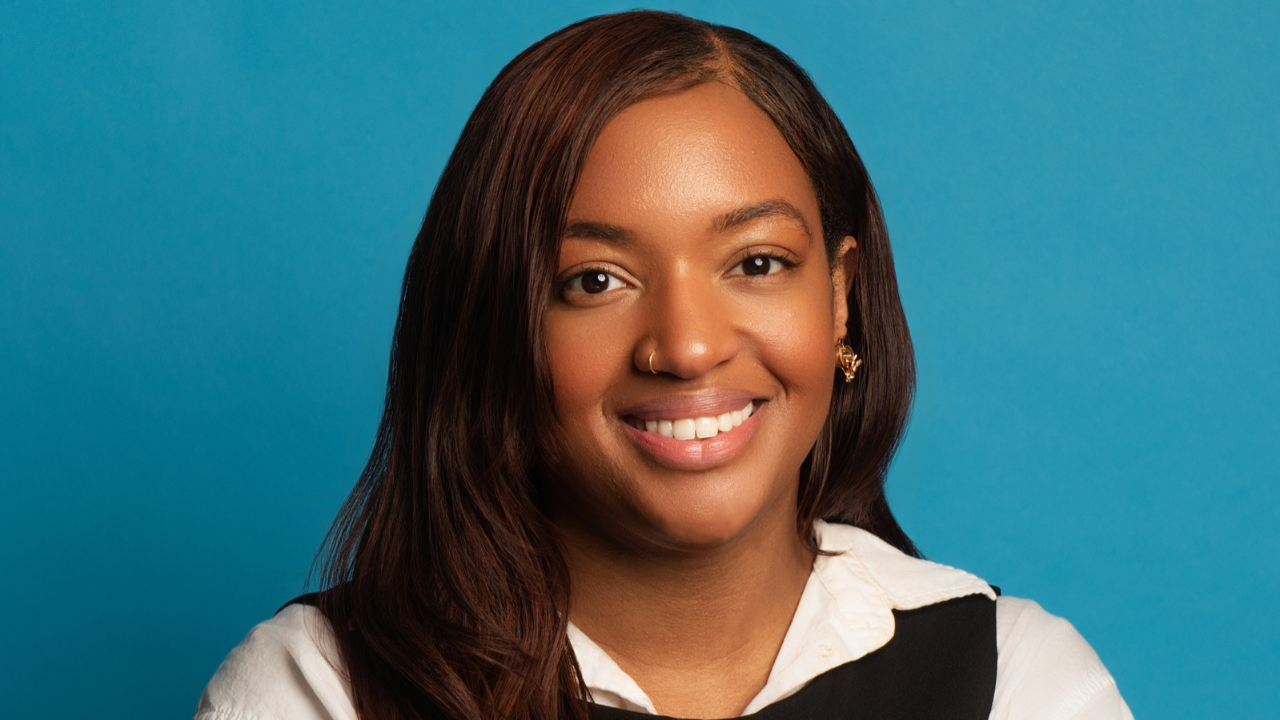
As the DCCC’s first Black national political director, Butler helped oversee more than $100 million in campaign programming and brought a new perspective to how Democrats engage Black voters and recruit candidates.
House Democrats are celebrating a historic majority in the next Congress (259 seats and counting) after November’s midterm elections. But what many may not know is that a Black woman played an integral role in making it all happen.
Brooke Butler, the national political director of the Democratic Congressional Campaign Committee, helped lead House Democrats’ campaign operations, from strategy and advisement for candidates to constituency engagement.
“I hope that in my role I’m able to lend a point of view that is different than what has been there,” Butler, the first Black person to hold the powerful position, told theGrio.
Butler’s rise at the Democratic Congressional Campaign Committee didn’t happen overnight. The 36-year-old Canton, Ohio native got her start in 2015 working on the digital team, where she got her hands in grassroots fundraising and communications.
“[It] taught me a lot about what people respond to and also, like, obviously, digital has exploded when it comes to political campaigns since then,” she said.
From there, Butler moved up the ranks to regional political director, where she advised candidates and their campaigns on general strategy and made recommendations to DCCC leadership about campaign needs, and how they could be most helpful to candidates.
She moved up the ranks to the organization’s independent expenditures team as deputy director, where she oversaw the DCCC’s paid media and voter communications across battleground districts.
As national political director, Butler worked in collaboration with party leaders, including the incoming House Speaker Hakeem Jeffries, to best position Democratic candidates for victory in their respective districts. Together they made history on multiple fronts.
Democrats won all 13 “frontline” districts with significant Black populations by an average of 15.3 points, outperforming 2024 Democratic presidential nominee Kamala Harris’s margin by 18.3 points. The party also won 6 of 10 “Red to Blue” districts and 6 of 9 “Districts in Play,” both with significant Black populations.
Those wins were built from strategy, says Butler, who manages DCCC’s organizing, digital, engagement, and political departments. As a result, the Congressional Black Caucus will see its largest membership since its founding in 1971.
“There are two moments in history where, relative to our population, we’ve had enough Black representation in Congress to see real impacts—Reconstruction Era and these past five years,” Butler told theGrio.
She added, “We’ve seen a measurable positive impact on Black people’s living conditions at both times. That’s very important to me, and it’s why it is an honor and a privilege to do this work and to help Leader Hakeem Jeffries become the first Black Speaker of the House.”
Butler led a $100 million budget that deployed canvassers who knocked on a record 7 million household doors (2 million more than the 2024 presidential election) and placed Black constituency engagement directors in key districts. She also spearheaded a new content creator program that generated tens of millions of views in key battleground states and expanded programs designed to reach Black and brown voters, including one new program focused on Black voters in rural areas.
The wins Butler and the DCCC secured came despite unprecedented racial gerrymandering in states across the South.
After the Supreme Court’s controversial decision in Louisiana v. Callais, which allowed Republican state legislatures to redraw election maps to dilute the voting influence of Black voters, Democrats in many of those districts still came out victorious. That includes U.S. Rep. Don Davis in North Carolina’s 1st Congressional District and U.S. Rep. Shomari Figures in Alabama’s 2nd Congressional District.
Even before the Callais decision in April, Butler said DCCC got out early in its messaging campaign to reach Black voters and ensure they were informed about the consequences of gerrymandering pushed by President Donald Tru,mp following the passage of his unpopular “One Big Beautiful Bill Act.”
“We started back in 2025 with communication to Black voters around things like healthcare and SNAP cuts, and just as things were happening,” Butler explained. “[We were] doing the work to make sure people were hearing about them, not just expecting them to.”
Butler said DCCC also conducted district-level polling of Black voters in order to help guide Democratic candidates on how to talk about the issues they cared about most.
“[Campaigns] can’t always do the research on their own to better understand the nuances for the Black voters in their district,” she told theGrio. “In one region of the country, housing may be what is popping with Black voters when you talk about cost, versus in a lot of our southern districts, groceries were the thing that was actually most top of mind.”
That tailored approach to the campaign delivered real results. Even in districts where Democrats failed to pull out wins, Butler said the party’s strategy and the strength of the candidates overperformed in districts where Republicans expected to win easily, such as Tennessee’s 9th Congressional District, where Democratic nominee Justin J. Pearson lost by just 1%.
Butler doesn’t take all the credit for Democrats’ historic wins—she also gave her flowers to Democratic leader Hakeem Jeffries, who on Jan. 3, will become the first African American to serve as House Speaker. She said Jeffries was focused on the party expanding its map and centering Black voters as a part of that strategy.
“He could not have been more clear about how important investing in Black voters was. His last stop on the trail was in Figures’ district to rally with him in Montgomery, which is the birthplace of the Civil Rights Movement,” said Butler. “When we have talked to him about our candidate recruitment, about how our races are moving and what they need, and whatever things need to be done, the Leader was always willing.”
As Democrats prepare to take the majority in January, Butler says she’s already focused on recruiting candidates and DCCC staff for the 2028 election cycle. She’s especially looking to further diversify the party.
“I believe that people with diverse perspectives bring a different thing to the country, and that’s important as somebody who has benefited from people being in rooms to push for different policies in my own life,” she said.
In the meantime, Butler is enjoying the fruits of her campaign labor as Democrats prepare to govern in Washington, D.C.
“I’m very proud and very happy about the change that we can enact with the House and Senate majority and what we can put a stop to,” she told theGrio. “Dnd then, ideally, come 2028, hopefully we elect a Democratic president, and we could really make some positive change in this country.”
More About:Elections
Weekly New Episodes
Stream Now