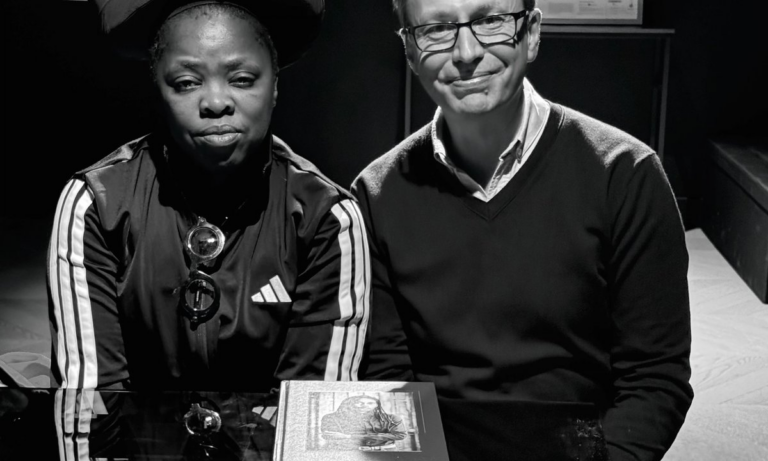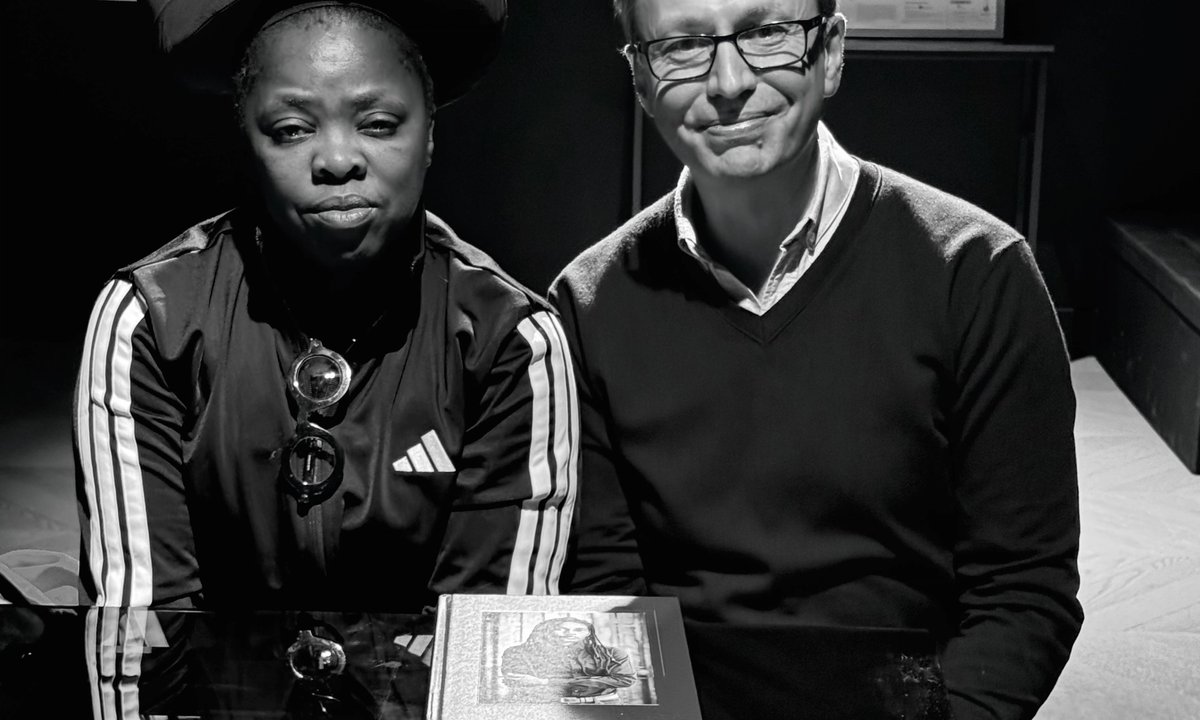
The artist Zanele Muholi and host Ben Luke
Photo: Banele Khoza
In this podcast, based on The Art Newspaper's regular interview series, our host Ben Luke talks to artists in-depth. He asks the questions you've always wanted to: who are the artists, historical and contemporary, they most admire? Which are the museums they return to? What are the books, music and other media that most inspire them? And what is art for, anyway?
Content warning: this episode has some discussion of sexual and homophobic violence.
Zanele Muholi, Zanele Muholi, Tembisa, Johannesburg, 2014, from Faces and Phases, ed. by Renée Mussai (MACK, 2026)
Courtesy of the artist and MACK
Muholi was born in 1972 in Umlazi, Durban, South Africa and lives today in Cape Town. They are a self-described visual activist, who, since the mid-2000s, have used photography to document the lives of LGBTQ+ people, initially in South Africa, where they were born.
Zanele Muholi, Diana Cristina Nascimento Ramos, Salvador, 2025, from Faces and Phases, ed. by Renée Mussai (MACK, 2026)
Courtesy of the artist and MACK
They have since expanded their project around the world and work in discrete, often ongoing series that have a common aim: to respond to violence and discrimination against queer and trans communities, to reflect their defiance and resistance, and to expand their visibility in visual culture in South Africa in particular but also far beyond.
Zanele Muholi, Ashara Ekundayo, Venice, 2026, from Faces and Phases, ed. by Renée Mussai (MACK, 2026)
Courtesy of the artist and MACK
The people they depict have, since the start, been far more than sitters or subjects; they are collaborators, participants who help define the way they are represented. A crucial factor is that Muholi turns the lens onto themself. “When I position myself in my own frame,” they have said. “I do so on my own terms attempting to articulate my own way of seeing and wanting to be seen.”
Zanele Muholi, Christine Madonsela, Daveyton, Gauteng, 2017, from Faces and Phases, ed. by Renée Mussai (MACK, 2026)
Courtesy of the artist and MACK
And whether it is their unflinching and tender portraits of their collaborators or their imaginative and improvised self-portraits Muholi’s photographs are always beautiful objects, with a fastidious attention to the properties and possibilities of their medium.
Zanele Muholi, Mantedieng ‘Mantis’ Mamabolo-Cunningham, Parktown, Johannesburg, 2018, from Faces and Phases, ed. by Renée Mussai (MACK, 2026)
Courtesy of the artist and MACK
They discuss the influence of their mother, who was a maker herself, and was a profound influence on one of their most notable works, Somnyama Ngonyama (2012). They reflect on the enormous impact of photographers including Rotimi Fani-Kayode, Lola Flash and Joan E. Biren, writers including Audre Lorde, and musicians including Brenda Fassie. Plus, they answer our usual questions, giving insight into their daily practices and the rhythms of their work, and reflecting on the ultimate question: what is art for?
This podcast is sponsored by Bloomberg Connects, the arts and culture platform.
Bloomberg Connects offers access to a vast range of international cultural organisations through a single click, with new guides being added regularly. They includeseveral guides to institutions that have shown and collected Zanele Muholi’s work, including SFMOMA in San Francisco, Tate in the UK, the Center for Visual Arts in Denver in the US, and MEP, the Maison Européenne de la Photographie in Paris. On the guide to the MEP, you will find features on its current exhibitions. They include Penn and Fashion, exploring the photographer Irving Penn’s long association with the fashion world, in which his stripped-back style has had a lasting influence on generations of photographers. You can hear audio features on all the sections of the exhibition, from his early years at Vogue magazine in the 1940s to the photographs made when Penn was in his 90s of Karl Lagerfeld, John Galliano and Christian Lacroix. You can also explore the related exhibition in La Petite Galerie, called Everyday Clothing, which allows young visitors and families to explore the creative process through works from the MEP’s collections.
Plus, Singapore's art scene and a photograph by Zanele Muholi