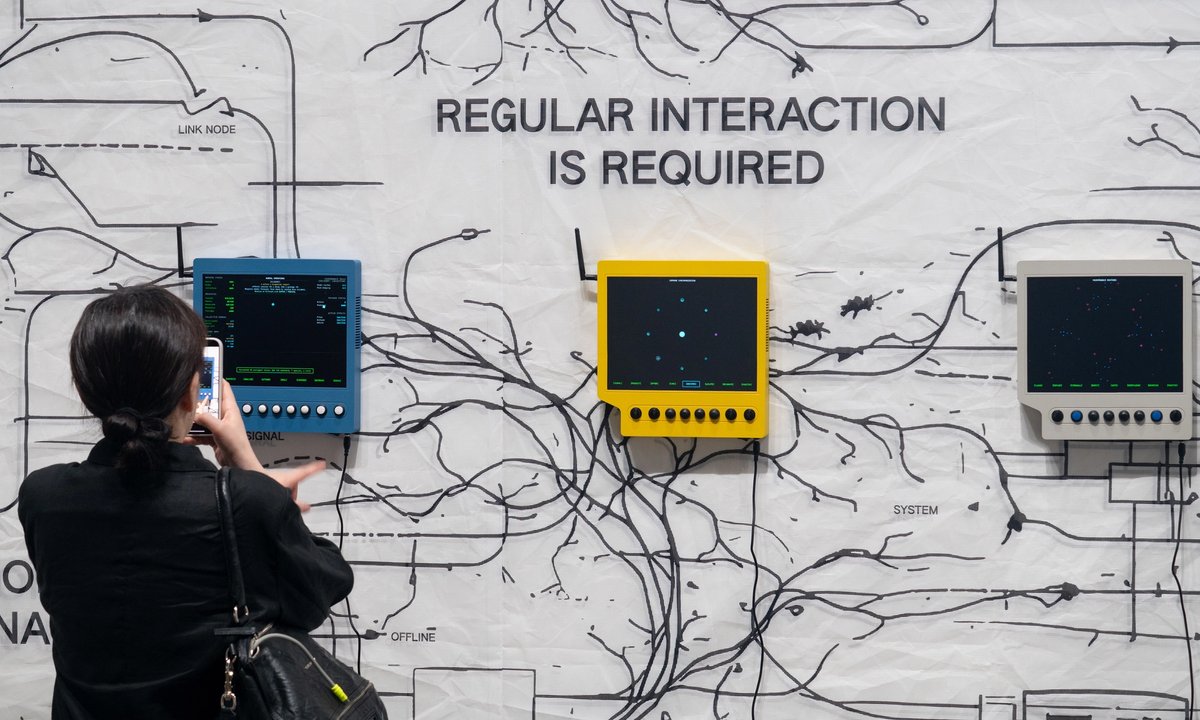
Works by Jonas Lund presented by OFFICE IMPART at Art Basel Hong Kong 2026 Courtesy of Art Basel
Insta’ gratification is a monthly blog by Aimee Dawson, looking at how the art world and social media collide. Each article tackles a topic around the innovations and challenges that spring up when art enters the digital world.
How do major collectors use social media to help them navigate the art world? The latest Art Basel & UBS Survey of Global Collecting 2026 report, which surveyed 3,100 high net-worth individuals (HNWIs) who collect art, shows that social media platforms—and Instagram in particular—are an increasingly important tool for discovering art and artists, buying works and promoting collections. Here is how online platforms are being used and what the art world can learn from it.
While the most common routes into collecting according to the report were the influence of family (28% of respondents) and cultural exposure through visits to museums, galleries, and fairs (22%), a surprising 13% discovered art collecting independently through online channels or social media. Interestingly, online channels were a less common route into collecting for Gen Z collectors (10%) than for Gen X (16%), “running against any assumption that younger collectors might be more likely to find their way to collecting through digital channels”, the report says.
The data also shows that those who started their art collecting journey online had higher levels of engagement with in-person exhibitions and events, both locally and overseas. “While being introduced to art through family or cultural exposure may reflect a more passive route into collecting, those who started out online were typically more active in seeking out art content,” the report says. “This suggests a more deliberate, self-directed collecting journey that carries forward into greater engagement with events later on.”
When it comes to collecting, 58% of respondents said they had used digital resources for advice with 32% of collectors citing either Instagram or X (formerly Twitter) as sources when it came to making purchases. Nineteen percent used recommendations from Instagram (up 2% year-on-year), including 22% of Gen Z respondents, and women were more likely to use them than men. The platform X—which has seen decreased usage in recent years due to controversies around its ownership and usage—was used by 18% of the sample, and this was again highest among Gen Z (23%).
A collectors’ likeliness to use social media recommendations for collecting also depended greatly on where a person was from: collectors in Hong Kong, the US and the UK were most likely to use social media for advice while those in Mainland China were less likely, undoubtedly due to the restrictions of social media platforms in the country.
Contrary to popular belief around the slow uptake of artificial intelligence (AI) in the art world, the study also showed that collectors trusted AI tools for art recommendations twice as much as those from social media and influencers, and also slightly more than in-store advisors and editorial content.
The importance of online and social media platforms in reaching collectors is growing. According to the survey, 27% of HNWIs’ total expenditure was made through such external platforms, up by 5 percentage points year-on-year and from 17% in 2024. The share of collectors buying directly from artists also grew to 69%, with 38% of works bought via Instagram, highlighting the benefits of a strong, independent social media presence for artists. It is also interesting to note that artist-direct spending through Instagram was higher among new collectors than more experienced ones: 8% for those in the market for two years or less, versus just 2% for those collecting for 20 years or more.
But can seeing a work online really seal the deal? Apparently so—among the 75% of respondents who had purchased a work directly from a dealer in 2025/2026, 53% had bought via Instagram without viewing the work in person, up from 43% in 2024.
The report interestingly states that the youngest generation of collectors—Gen Z—are not the ones using social media the most in their collecting journeys. “The generation raised on social media is, it turns out, the one most inclined to keep its collecting close,” the report says. While the data showed that Gen Z were the highest-spending generation surveyed and had the most wide-ranging collecting habits, their awareness of digital footprints leads them to seek greater control and privacy over their "personal and cultural identities".
“Anonymous accounts and smaller, niche social networking platforms allow them to communicate in ways that feel less pressurised and performative,” the report states. “With social media feeds heavily controlled and populated by algorithms rather than personal networks, Gen Z consumers are increasingly interested in taking back control over who sees their personal content by sharing it with smaller, vetted and carefully chosen audiences.”
When it came to sharing information about their collections with the wider public, only 25% Gen Z shared their own content publicly, compared with 36% of millennials and around one third of other older collectors.
The latest “Survey of Global Collecting” from Art Basel and UBS also found a growing number of buyers are bypassing dealers and auction houses to purchase directly from artists
The hashtag #findartthatfits, an initiative of Woolwich Contemporary Print Fair, is part of an art advisory campaign to assist prospective buyers
Did art dealer Kenny Schachter's predictions for the app hold true?
Dubbed "the world's new big art dealer" the platform is often used to spark interest in sales and helps artists and galleries to grow international brands