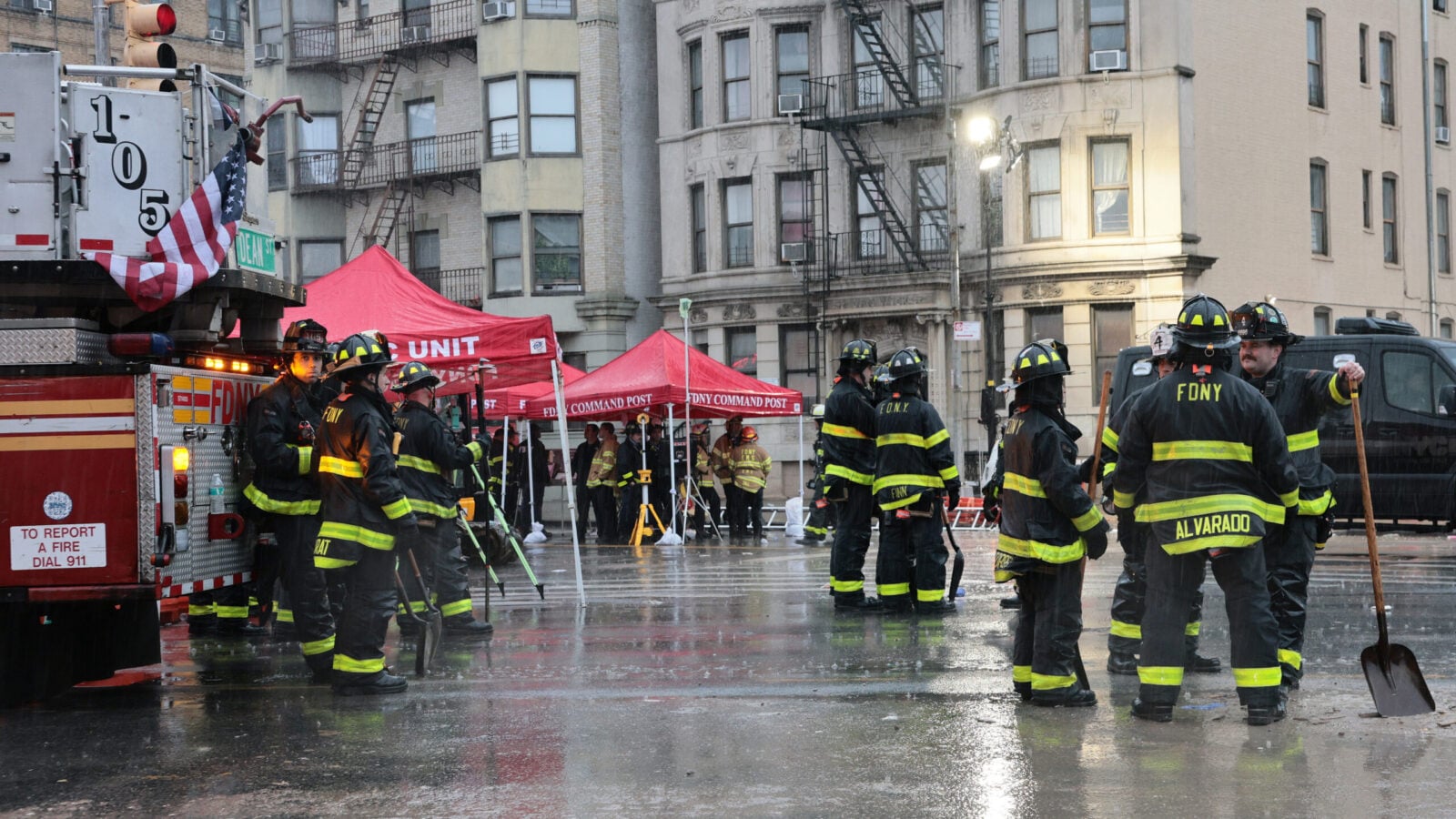
An apartment building collapsed in Flatbush on Wednesday afternoon, killing at least eight and injuring several others.
After a building collapsed in Flatbush, and as the death toll continues to rise, a predominantly Black and immigrant community has been left seeking answers in the aftermath.
On Wednesday, Nov. 11, a three-story apartment building at 1321 Flatbush Avenue collapsed into an adjacent construction site, killing at least eight people and injuring over 17 others, including multiple children.
One woman pulled from the rubble alive during a rescue that brought tears to the eyes of many who witnessed it was six months pregnant.
“There are no words for a loss of this magnitude,” New York Mayor Zohran Mamdani said in a lengthy post on X on Thursday. “My heart is with the families and loved ones of those we have lost, those who are injured and everyone grieving today.”
The tragedy has left residents of the predominantly Black and immigrant neighborhood grappling with the loss and uncertainty about what comes next. The development is under renewed scrutiny; the construction site next door had a history of safety violations. For community organizers working to support those impacted, the immediate aftermath has also brought renewed urgency to longstanding concerns about development and safety in the neighborhood.
While investigators are still working to determine an exact cause, the neighboring construction site at 2625 Bedford Avenue had been cited earlier for violating a stop-work order issued over inadequate safety protections, and city officials have since launched inspections of approximately 100 other construction sites connected to the developer, Gothamist reported. Meanwhile, the building that collapsed also had 98 open housing-code violations.
For Jerrell Gray, a Black urban planner and organizer in the community, the tragedy has exposed the consequences of rapid development in a neighborhood where longtime Black and immigrant residents of the community dubbed “Little Caribbean,” or “Little Haiti,” have faced growing displacement since the early 2000s.
“Flatbush is home to one of the largest—if not the largest—Caribbean immigrant communities in New York for sure and possibly in the United States. It’s a very Black neighborhood that has experienced very large Black population loss,” Gray told theGrio.
He added how this tragedy is also illuminating a major and nuanced safety issue.
“New York City has a ton of older housing stock that has been the crux of preventing people from being displaced because of affordable rent stabilization,” he said.
However, this then can leave tons of older properties vulnerable to decay, decline, or potentially even worse.
Beyond the immediate devastation, the community organizer said the collapse has also renewed concerns about the safety of existing residents as developers continue reshaping the neighborhood. While additional housing remains necessary, he stressed that the need to build should not come at the expense of the people already living there.
“If there’s a building that has received a stop-work order, they should be monitored going forward. There should be continuous inspection, and checking in once you see one violation, because people’s lives are at risk,” Gray said.
For now, community organizers like Gray are focused on helping families recover, including connecting displaced residents with housing, financial assistance, and other resources. Jerrell urged those looking to help to coordinate with local relief efforts rather than dropping off unsolicited donations.
Residents who have been displaced by this current tragedy have been receiving emergency assistance through the American Red Cross, which established a reception center at the Flatbush YMCA located at 1401 Flatbush Avenue.
Gray also recommended making donations through the Mayor’s Fund to Advance New York City, which accepts donations for emergency relief. Or the Flatbush YMCA, which might accept gift cards. He also suggested donating masks, which could be useful for residents living near the collapse site, given all the dust and debris in the air.
Until more information is available, how preventable another building collapse is uncertain. But it stands to reason that something can be learned as cities across the country grapple with the need for more development amid older communities living among them.
“We need housing,” Gray said, adding that, “Oftentimes, Black and brown immigrant working-class neighborhoods are the neighborhoods that take on most of the development. And when things go wrong, when people cut corners, when people prioritize speed over quality and people’s safety, we also have to deal with the consequences.”
More About:Lifestyle
Weekly New Episodes
Stream Now