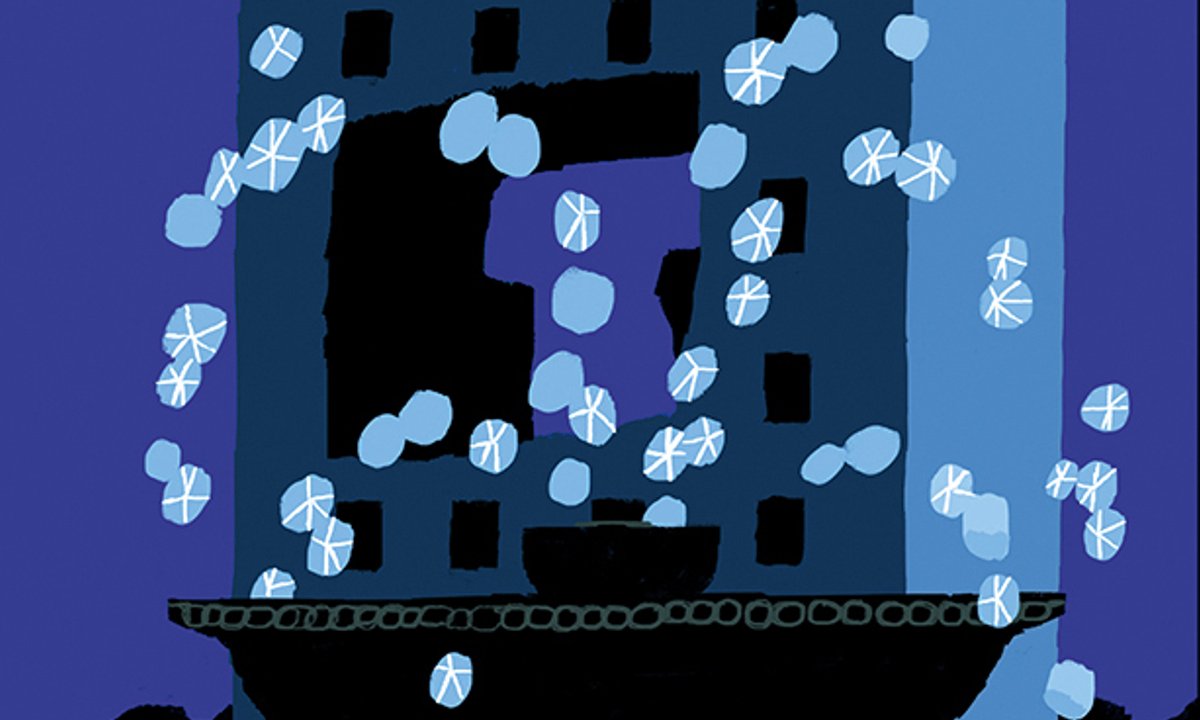
Cover illustration by Kyiv-based Ukrainian artist Sergiy Maidukov
Courtesy Jonathan Cape
As the war grinds on in Ukraine, almost five years after Russia’s full-scale invasion, The Guardian’s chief culture writer Charlotte Higgins reminds us in her timely and sobering new book how artists and writers register the human cost of the conflict.
“The argument of this book is that the literature and art made by these people, some of whom have lost their lives, will shape the war’s memory,” Higgins boldly asserts. Artists, writers, poets and filmmakers are her vital and sympathetic touchstones across cities such as Kyiv, Kharkiv and Lviv.
“When a friend, the defence and security editor of The Guardian, suggested I might think about going to Ukraine, I agreed immediately that it was a good idea,” she writes. “I said it lightly, impulsively, and without realising that going there would change me.”
This odyssey begins in the autumn of 2022, encompassing three years of reporting trips to Ukraine. The arc of the narrative is epic and emotional, from arriving in Kyiv on a bright, beautiful day (10 October) to a final documentary account of the destruction of Bakhmut in the east, where an elderly lady called Nina surveys streets blitzed by shell holes that “were once perfectly ordinary”.
Along the way, Higgins deftly interweaves personal milestones such as slowly grasping the Ukrainian language—who knew “verbs of motion” could be so onerous?—detailing how “the war leaked into every [language] lesson”. Dealing with the anger felt by Ukrainians facing “the outrage of violence” is another test for the author, who anchors her account by observing the impact of Ukrainian art and artists, both historic and contemporary.
As testament to the violence and destruction, Higgins draws on a film by the Kharkiv artists Daniil Revkovskyi and Andrii Rachynskyi shown in the Ukrainian pavilion at the 2024 Venice Biennale. Civilians. Invasion (2023) is an hour-long collage of unedited videos found online that mirror the true reality of constant bombs and bullets.
Higgins’s survey of artists is essential as a journal of record, bringing to the fore figures such as Marharyta Polovinko, whose macabre, penetrating drawings of roaming monsters can be set, Higgins argues, alongside the work of Spanish artist Francisco Goya—famed for The Disasters of War (1810-20)—or the First World War and Weimar imagery of the German painter Otto Dix. Immortalising these creative figures, who may go unnoticed outside Ukraine, is a significant commemorative act (Polovinko was killed in action in 2025, aged 31).
A trained classicist, Higgins frames the events and trauma of the war through Greek mythology. She likens the character of Cassandra—who was condemned to prophesy only the truth but never be believed—to “resolute Ukrainian women, eloquent and truth-telling”, neatly segueing into one of Ukraine’s greatest works of literature, a seminal poem written by Lesya Ukrainka around 1907 (Cassandra: A Dramatic Poem).
Victoria Amelina, a Ukrainian novelist and war crimes investigator who died aged 37 in July 2023 from severe injuries sustained during a Russian missile strike, is one of these “Pale Cassandras”. Amelina was instrumental in bringing to light the buried journal of the late writer Volodymyr Vakulenko who documented life under occupation.
In commemorating friends and colleagues like Amelina, Higgins is searing and eloquent. “[…] grief leaked out of me,” she says, “and I felt like a vessel with no shape, porous, lacking capacity to hold anything.” Such frank admissions could jar but in shaping a war’s memory, this narrative benefits from such measured, personal interludes.
Cultural erasure is a weapon of war: at least 120 Ukrainian museums have been damaged in the conflict, according to the country’s culture ministry. Russian president Vladimir Putin is not only attempting to annihilate the military and political leadership, but also its cultural warriors in a ruthless bid to vanquish the existence of a sovereign Ukraine. Higgins’s book is a bulwark against this campaign; as a personal memoir it is deeply affecting, and as a journalistic record it is transformative.
• Ukrainian Lessons: Art in a Time of War, by Charlotte Higgins, published by Jonathan Cape, 272pp, £22 (hb), 20 August
The support structure of “Black Cloud”, a 100ft-tall assemblage of 45 interconnected forms, was broken in half by the hurricane-force winds that swept across the Black Rock Desert
“Rule of Two Walls”, showing at the Tribeca Film Festival, follows artists in Ukraine after the launch of Russia’s invasion
Among the institutions that were hit are the National Art Museum of Ukraine and the National Chornobyl Museum, Ukraine’s culture ministry reports
The satellite fair’s new director visited Kyiv in the spring to forge partnerships with artists and dealers there