

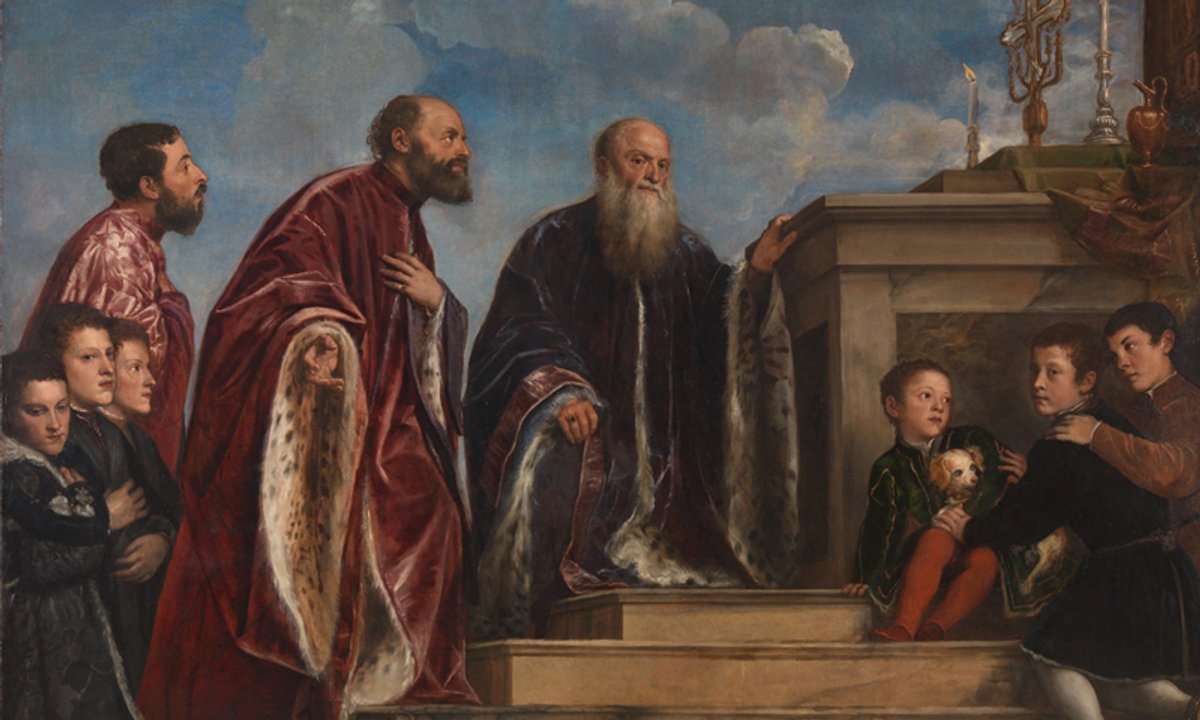
Complex weave: Titian’s The Vendramin Family (around 1540-45) © The National Gallery, London
In 14th-century Siena and 15th-century Florence, paintings were largely on walls or panels. Then, over the course of the 16th century, the prestige of Venice’s painters brought with it the triumph of canvas, more suited to the damp Venetian climate than plaster, and cheaper and easier to transport than wood. But how did artists like Titian, Veronese and Tintoretto actually use this new material? The British art historian Cleo Nisse has provided a whole new way of looking at these innovations in Venetian Canvas and the Transformation of Painting. Here are four takeaways from the book.
Canvas is a familiar enough word but Nisse reveals a vast, complicated and fascinating world of materials, twills and textures. At first, Venetian artists were drawn to a so-called “tabby weave”, whose smoother surface was closer to panel. Gradually they came to master rougher weaves, in particular a herringbone pattern that fostered gaps in the painting’s surface.
Many of these canvases, which could be made of either linen or hemp, might have had other purposes. For example, Tintoretto’s The Miracle of the Slave (1548) was painted on sail cloth. The complex weave pattern of Titian’s The Vendramin Family (around 1540-45) was fine enough for a tablecloth, and Nisse argues that the weave itself helped him create the “diffuse and soft” quality of light.
Canvas, so strongly associated with the Venice Cinquecento, was actually a very familiar support in the late Middle Ages. Painting on canvas had served as an alternative to tapestry or embroidery, and what is regarded as a breakthrough canvas work, Gentile Bellini’s Il Beato Lorenzo Giustiniani (1465), may once have been a processional banner.
Vittore Carpaccio's The Martyrdom of the Pilgrims and the Funeral of Saint Ursula (around 1490s)
As early as 1474, Bellini was replacing frescoes in the Great Council Hall of the Doge’s Palace with paintings on canvas—a stark case, Nisse argues, of “historical transition”. But it was Bellini’s pupil, Vittore Carpaccio, who first mastered canvas, in all its intricacies, in his series The Legend of St Ursula, in which he varied the type of canvas in successive paintings for differing effects. In The Martyrdom of the Pilgrims and the Funeral of Saint Ursula, Nisse says, he first used a rougher herringbone weave that was best suited to convey the dynamism of the massacre.
The book culminates with a striking, support-minded interpretation of Titian’s last work, Pietà, painted on a patchwork of ever-rougher canvas. The irregularity meant “it would have been very hard for Titian to ever have achieved a highly finished surface”, Nisse says, attributing the painting’s celebrated effects beyond its loose brushwork, or (as legend has it) the artist’s failing eyes, to its support.
• Cleo Nisse, Venetian Canvas and the Transformation of Painting, Princeton University Press, 288pp, $68/£58 (hb)
For artisan Helena Loermans, uncovering the intricate weaves of artists' canvases is like “a detective story”
Belgian collector Marnix Neerman revealed as buyer as exhibition of masterpieces from Flemish collections opens at the Palazzo Ducale this week
These two books—very different in approach—analyse the process and works of the Italian Renaissance painter