

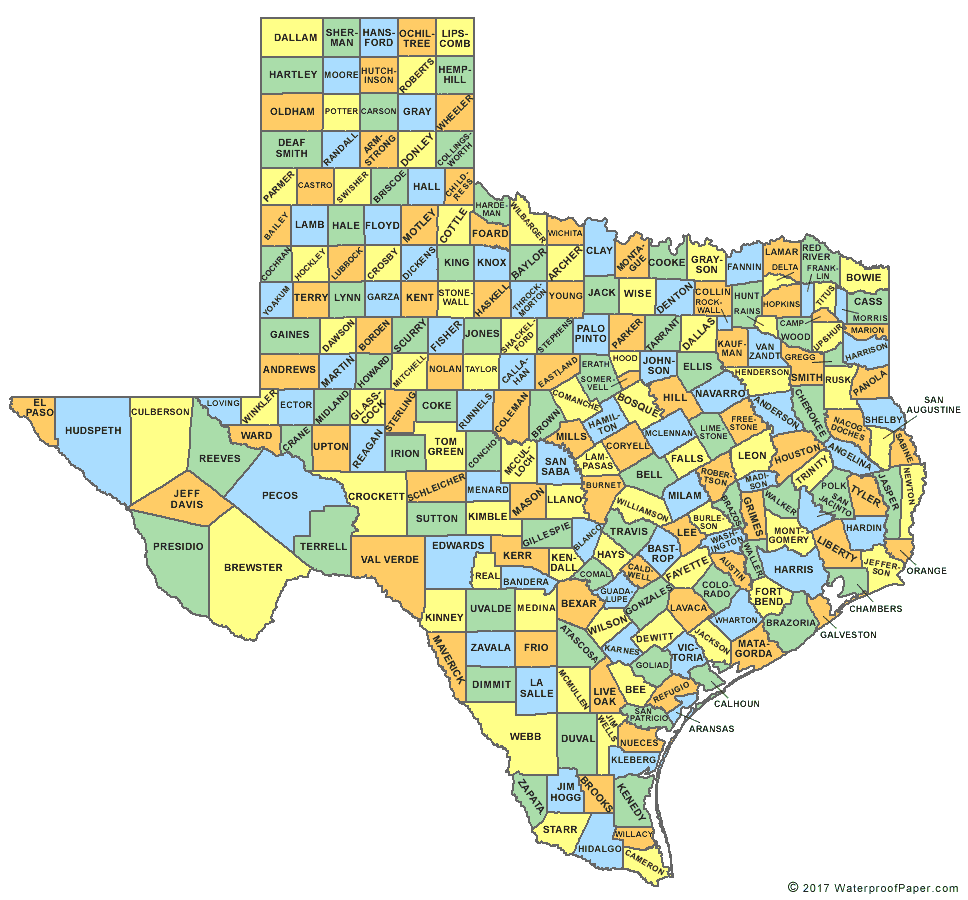
Texas counties
Image courtesy WaterproofPaper.com
Waves of racial tension began to form at the port of Brownsville almost immediately after the erection of dock facilities in 1934. The International Longshoremen’s Association (ILA) organized the piers by establishing the all-Black Local 1368 and the all-white Local 1367. In the port’s first six years of operations, shipping companies almost exclusively hired white dock workers. In 1940, the ILA revoked Local 1368’s charter until available work for them increased. Following the union’s decision, Black longshoremen brought their grievances to a local NAACP conference in the same year. There, the notable Thurgood Marshall agreed to serve as their legal counsel and sought federal intervention on their behalf.
With the assistance of Thurgood Marshall, Brownsville’s Black dock workers filed complaints with the Fair Employment Practices Committee (FEPC) under Executive Order 8802. Issued by President Franklin D. Roosevelt in June 1941, the wartime measure prohibited racial discrimination in the defense industry. The FEPC served as the Order’s compliance agency, but had no enforcement powers. The Committee could only receive and investigate complaints. The NAACP considered the FEPC to be largely ineffective in its five-year tenure.
In a late May 1942 letter to Marshall, the FEPC declined to investigate Local 1368’s racial discrimination claims. The Committee insisted that the Black longshoremen did not specify whether the violation stemmed from the union or individuals working as stevedores, but Marshall clearly identified that the ILA was the crux of the problem in previous correspondence. The all-black Local 1368 remained inactive for another six years due to the FEPC’s inaction.
Following WWII, the Brownsville docks experienced a revival in shipping traffic which renewed the need for black labor. At the 1948 ILA Gulf District convention, union executives reactivated Local 1368’s charter, but coerced the Black longshoremen into signing an agreement that provided them with 25% of all cargo work, but gave 75% of all labor to Local 1367. The unequal quota system was a racist tactic to ensure that Local 1368 received the less work and dirtiest tasks such as loading and unloading led and ore. Whereas, white dockers maintained the most job assignments and lightest duties. Despite fruitless attempts to negotiate new contract provisions with Local 1367, Brownsville’s Black longshoremen remained committed to obtaining equal employment opportunity.
Local 1368 passed a resolution to eradicate the one-fourth restriction in their collective bargaining agreement at the 1956 Gulf District meeting, but the ILA’s executive council rejected their petition. Due to continued union suppression, Black longshoremen filed discrimination charges with the NLRB in April 1963. The Gulf District’s presidency office immediately placed Local 1368 under trusteeship and stripped the unit of its officers. White backlash did not deter the Black longshoremen’s quest for justice.
After a brief three-day trial from July 24-26, 1963, the NLRB issued its first decision in favor of Local 1368 seven months later. On February 5, 1964, the Board condemned the 75%-25% quota system that disadvantaged Black dock workers. The NLRB’s decision required the ILA to relieve Local 1368 of trusteeship and pay back any expenses they accrued since filing their initial charges, but the opinion did not immediately change the uneven labor rations. The Board instructed ILA executives and Local 1368 to meet and rearrange the contract provisions.
Subsequent to the all-white Local 1367’s appeal, the case reached the NLRB for the second ruling in mid-September 1964. The Board upheld its previous ruling, but also demanded that the ILA implement a 50-50 allocation of labor between both Brownsville longshoremen locals. The NLRB found the union in violation of Section 8(d) of the 1947 Taft-Hartley Act which commands unions and employers “to confer in good faith.” The Board saw that the current collective bargaining pact infringed on Local 1368’s rights under law.
The NLRB’s final decision was precedent-setting in that it was the first to prohibit racial quotas under labor law for the first time in history. Ironically, the Board’s decision was a triumph for Local 1368, but it also upheld a “separate but equal” philosophy at a time when the federal government began mandating full integration as a necessity in reaching equality. While not effective until July 1965, Title VII or the employment discrimination section of the 1964 Civil Rights Act prohibited segregated union locals.
D. Caleb Smith is an assistant professor in the Department of History and an affiliate of the Critical Race and Political Economy Department at Mount Holyoke College in South Hadley, Massachusetts. He earned his B.S.Ed. in Social Studies Secondary Education from Delta State University and a M.A. in History from Jackson State University. Smith obtained a graduate certificate in community-engaged scholarship and a doctorate in History from Tulane University. His research interests include African American, civil rights, labor and legal history. Smith has received fellowships, grants, and honors from the American Society for Legal History, the Andrew Mellon foundation, the Association for the Study of Law, Culture, and the Humanities, the New Orleans African American Museum, and the New Orleans Center for the Gulf South. His scholarship appears in Africana Annual, American Journal of Legal History, Black Educology Mixtape Journal, Labor History, and Left History.
A small donation would help us keep this available to all. Forego a bottle of soda and donate its cost to us for the information you just learned, and feel good about helping to make it available to everyone.
BlackPast.org is a 501(c)(3) non-profit and our EIN is 26-1625373. Your donation is fully tax-deductible.
CITE THIS ENTRY IN APA FORMAT:
Smith, D. (2025, September 16). Black Longshoremen and Civil Rights Activism in Brownsville, Texas (1964). BlackPast.org. https://blackpast.org/african-american-history/black-longshoremen-and-civil-rights-activism-in-brownsville-texas-1964/
Local 1367 and Local 1368 ILA, AFL-CIO. 148 NLRB No. 44. (1964).
“NLRB Reiterates Stand: Rules Racial Prejudice Violates Labor Laws,” Pittsburgh Courier, September 26, 1964.
Hill, Herbert. Black Labor and the American Legal System: Race, Work, and the Law. Madison: The University of Wisconsin Press, 1985.
December 22nd, 2018
June 11th, 2008
October 17th, 2013
March 11th, 2010
December 25th, 2008
January 6th, 2010
August 31st, 2010
March 15th, 2012
Contact Us
Write For Us
How You Can Help Us
Accessibility
©2007–2025 BLACKPAST.ORG. ALL RIGHTS RESERVED.
BLACKPAST.ORG IS A 501(C)(3) NONPROFIT ORGANIZATION. THE EIN IS 26-1625373. ALL DONATIONS ARE TAX DEDUCTIBLE.
Donate today to help us advance Black history education and foster a more inclusive understanding of our shared cultural heritage.
Are you passionate about Black history and storytelling? Join our team as a content contributor to share powerful stories, highlight key events, and celebrate the legacy of Black communities worldwide!
Teacher strategies for effectively incorporating the website into everyday instruction
Find useful resources and websites to help further research and explore Black history.
Explore popular & historically significant entries specially tailored for a children’s audience (7-12 yrs).
BlackPast.org pages that we think would be particularly valuable to share with young people
This editorial page is part of an ongoing effort to present the ideas and opinions of individuals both within and beyond BlackPast.org that address the pressing issues and challenges facing African Americans and people of African Ancestry around the world, which are rooted in their historical experiences.
Explore the legacy and leadership of Africa’s past and present heads of state, showcasing the visionaries who have shaped the continent’s history and future.
Discover the rich and inspiring stories of Black history through our interactive timeline, highlighting key moments and figures that have shaped our world. Dive in and explore how history connects to the present and inspires the future!