

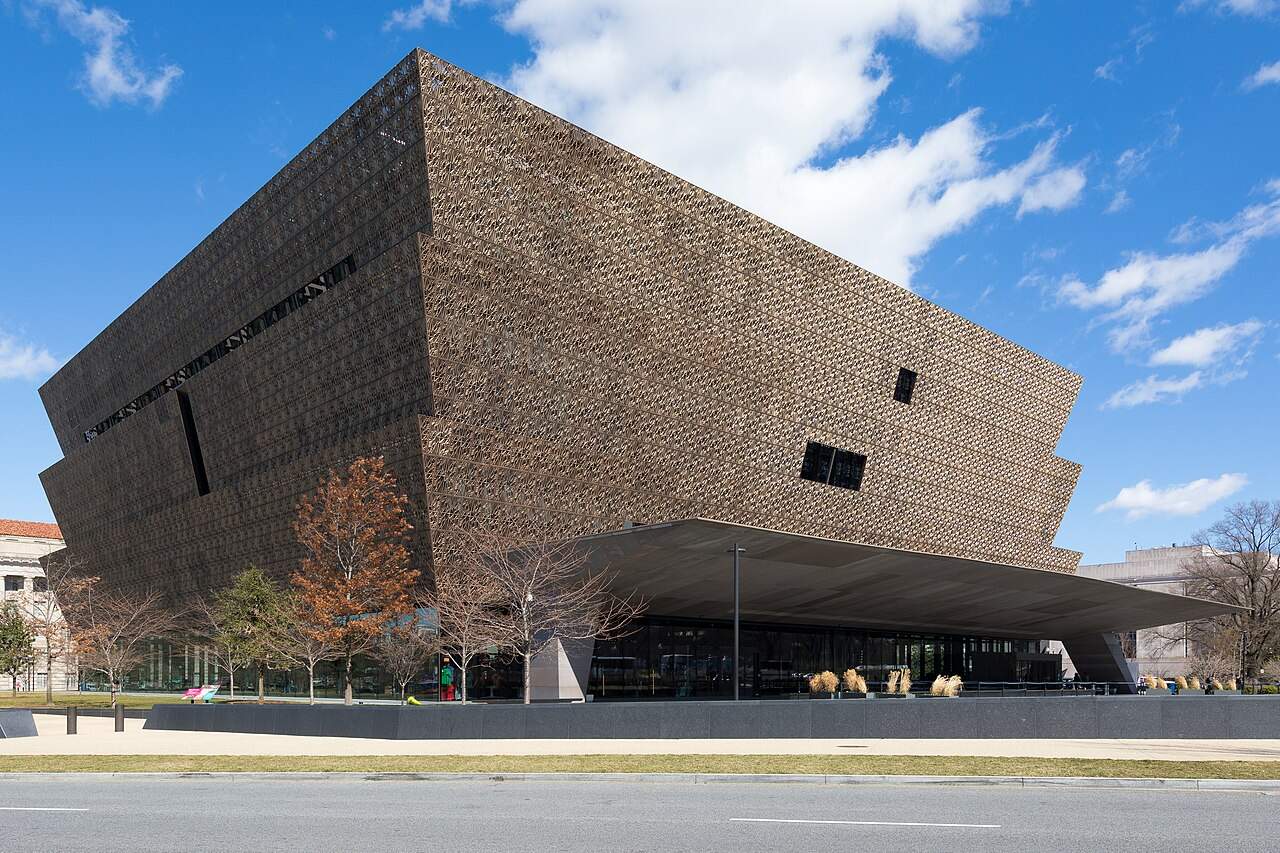
The exterior of the National Museum of African American History and Culture in Washington, D.C., on February 27, 2020, as seen from 15th Street NW
Photo by Frank Schulenburg(CC BY-SA 4.0)
When a nation tells the truth about itself, it gives future generations the tools to do better. That is why the Smithsonian Institution and other museums that document the history and afterlives of slavery are not “out of control”—they are doing the hard, patriotic work of memory. Recent efforts by President Donald Trump to pressure the Smithsonian to deemphasize “how bad slavery was,” to reframe exhibits as less “divisive,” and to order a sweeping review of museum content are wrong on the facts and dangerous for our civic health.
What’s happening—and why it matters
In public statements and directives, President Trump and his team have targeted the Smithsonian’s approach to American history—complaining that museum displays dwell too much on slavery and other painful chapters and signaling plans for legal or administrative review of content across multiple museums. Reporting has documented a 120-day timetable for “revisions,” the demand to replace “divisive” language with “unifying” phrasing, and an explicit call to downplay the centrality of slavery to the American story. These moves echo broader attempts to substitute political messaging for professional historical practice.
The Smithsonian’s museums are federally funded but operate with scholarly independence for a reason: Americans deserve history that is researched, peer-reviewed, and responsibly interpreted—not history edited by politicians. Attempts to scrub, minimize, or euphemize the history of slavery do not “unify” the nation; they impoverish our understanding and make it harder to recognize patterns of harm that still shape our society.
What museums do right—every day
Across the United States there are 178 museums in 39 states that have spent decades building rigorous, empathetic, and deeply documented exhibitions that help visitors grasp the human reality of slavery and its legacies:
This is not ideology; it is scholarship, collections, and pedagogy. It is the painstaking accumulation of evidence—ships’ logs and bills of sale, iron shackles and freedom papers, quilts and letters—curated to tell the truth humanely.
Why minimizing slavery’s history harms everyone
The stakes for the Smithsonian—and for us
The Smithsonian belongs to the American people. Its Secretary, curators, educators, and conservators are stewards of a national memory that must include the brilliance of American achievement and the brutality that also shaped it. Attempts to re-script exhibits to avoid “negative parts” of our past—especially slavery—do not make us prouder; they make us more fragile. And fragility cannot support a democracy.
If anything, the Smithsonian and its partners should be empowered to do more: expand community-sourced archives, fund descendant-driven research, deepen digital access to collections, and connect slavery’s history to the present with clarity and care. That is the path to unity—truth, reckoned with together.
A final word
Black history is American history. Defending its honest presentation is not a partisan project; it is a patriotic obligation. Museums that tell the full story are not tearing the country down—they are building the foundation on which a better country can stand.
Yes, I’m passionate about being an American, and about my Black heritage. I’m passionate about my children and their children and their children’s children knowing from whence they came…to be informed by it and inspired by it. But they can’t be either just knowing only half of the story. They need to know the good and the part that is embarrassing for the country. By doing so they become wholly complete citizens and productive contributors of this country and the world.
I’ve said it before and I reconfirm now, let society protect and preserve and honor and share the sacred lived experiences and contributions of all who made their way to this country.
I remain…in defense of Black museums.
Over time, Douglas Bender has held several leadership and board positions with for-profit and nonprofit organizations, including local industrial commission advisory boards and Chambers of Commerce. He serves as Chairman of the Board for MJC & Associates, Inc., a Houston, Texas-based mobile notary firm, and was a Board Member of Virtual Sports Training, Inc. (VST) of Orange County, California, a leading-edge sports technology corporation.
He served on the Executive Advisory Board for the Los Angeles chapter of the National Association of African Americans in Human Resources and as the Executive Program Coordinator for the California State University – Long Beach Human Resources Professional Certificate Program for eight years. He served on the national board of Sigma Pi Phi Fraternity for six years, chairing several national committees (including History & Archives), and is now Chairman Emeritus of Base 11, a national STEM nonprofit and workforce accelerator.
Doug served as a church Trustee for almost twenty years and was Vice President of the Friendship Development Foundation (community non-profit) board in Yorba Linda, California. He currently serves as Trustee of the Bender Family Trust administered by the American Baptist Foundation in King of Prussia, Pennsylvania. He also chaired the Villa Park (California) Community Service Foundation for five years, the first African American to be elected or appointed in the city’s history. He was Chairman of the Human Rights Commission of Greensboro, North Carolina, and was the inaugural Chair of the City’s Cultural Affairs Commission on which he still serves today.
Doug has been involved with the World Business Academy as a Fellow (2004- 2006), the International Neocasting Alliance as a Charter member (2005 – Present), Forbes.com Small Business Insights Panel member (2006 – 2010), and is a member of the Worldwide Network for Servant-Leadership (2009 – Present).
He has been an Adjunct Instructor at the heralded California State University campuses at Long Beach and Fullerton and has lectured many international business leadership delegations from around the world, including The Peoples Republic of China. He is currently an Adjunct Associate Professor at the University of Southern California’s Bovard College and a visiting lecturer to the Marshall School of Business Leadership Fellows Program.
Along with many published professional articles written over the course of his career he has also published the award-winning book, The ABC’s of Leadership in 2008 (Axiom Business Book Awards) and a second book, Caution: Smiles at Work (lulu.com, 2014). In addition, he is a Contributing Author to the bestseller, The Leadership Challenge Activities Book by Kouzes and Posner (Pfeiffer, 2010).
Doug appears in several regional, national, and international editions of Who’s Who. He and his wife, Belinda, have eight adult children and thirteen grandchildren.
A small donation would help us keep this available to all. Forego a bottle of soda and donate its cost to us for the information you just learned, and feel good about helping to make it available to everyone.
BlackPast.org is a 501(c)(3) non-profit and our EIN is 26-1625373. Your donation is fully tax-deductible.
CITE THIS ENTRY IN APA FORMAT:
Bender, D. (2025, September 29). Why Honest Museums Make a Stronger America. BlackPast.org. https://blackpast.org/in-defense-of/why-honest-museums-make-a-stronger-america/
February 6th, 2019
July 28th, 2007
February 12th, 2007
August 13th, 2008
July 26th, 2013
October 15th, 2018
November 29th, 2023
March 12th, 2020
Contact Us
Write For Us
How You Can Help Us
Accessibility
©2007–2025 BLACKPAST.ORG. ALL RIGHTS RESERVED.
BLACKPAST.ORG IS A 501(C)(3) NONPROFIT ORGANIZATION. THE EIN IS 26-1625373. ALL DONATIONS ARE TAX DEDUCTIBLE.
Donate today to help us advance Black history education and foster a more inclusive understanding of our shared cultural heritage.
Are you passionate about Black history and storytelling? Join our team as a content contributor to share powerful stories, highlight key events, and celebrate the legacy of Black communities worldwide!
Teacher strategies for effectively incorporating the website into everyday instruction
Find useful resources and websites to help further research and explore Black history.
Explore popular & historically significant entries specially tailored for a children’s audience (7-12 yrs).
BlackPast.org pages that we think would be particularly valuable to share with young people
This editorial page is part of an ongoing effort to present the ideas and opinions of individuals both within and beyond BlackPast.org that address the pressing issues and challenges facing African Americans and people of African Ancestry around the world, which are rooted in their historical experiences.
Explore the legacy and leadership of Africa’s past and present heads of state, showcasing the visionaries who have shaped the continent’s history and future.
Discover the rich and inspiring stories of Black history through our interactive timeline, highlighting key moments and figures that have shaped our world. Dive in and explore how history connects to the present and inspires the future!