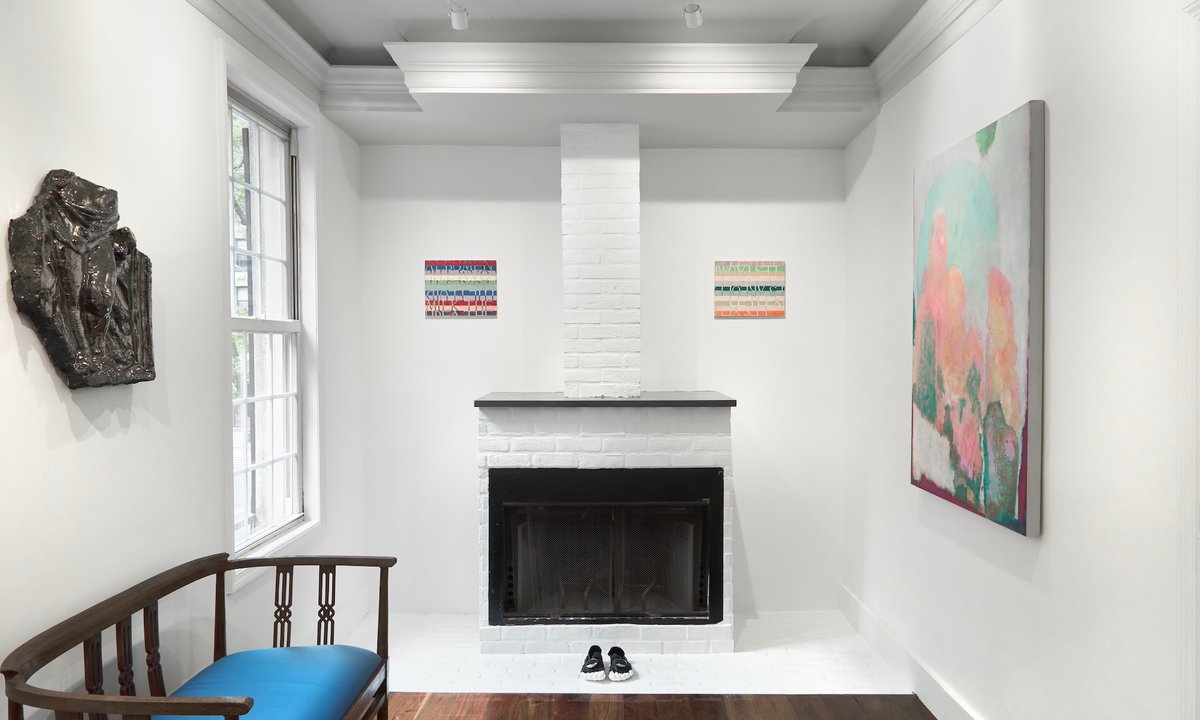
Installation view of As if a line at Slip House Courtesy Slip House. Photography by Software Studios
Behind an intricately carved metal gate on East 5th Street sits Slip House, a new gallery co-founded by Ingrid Lundgren and Marissa Dembkoski. The inaugural group exhibition, As if a line (9 May-14 June) features a cross-generational group of painters, including heavy-hitters Jack Whitten and Claude Viallat, as well as a set of rising talents such as Lizzy Gabay, Alix Vernet, Max Guy, Nour Malas, Rachael Bos, Jill Tate, and Noelia Towers.
The cross-generational debut show reflects the founders’ mission, Lundgren says, of “dismantling the hierarchies and [to] look how we can contextualise institutional artists with younger names”. Lundgren tested this approach with her previous enterprise, Winter Street Gallery, which had a five-year run on Martha’s Vineyard. Dembkoski was previously a development associate at the St Louis Art Museum and worked at Document gallery in Chicago.
Slip House's founders Marissa Dembkoski (left) and Ingrid Lundgren (right) Photo by Taylor Augustine
Another ambition behind the endeavour is to facilitate discovery. The German artists Katharina Schilling and Paula Kamps are making, respectively, their US and New York debuts with their figurative paintings of daily life veiled with reverie. “We are interested in some CV-matching and creating a melting pot of experiences within the ecosystem,” Dembkoski says. She describes this first show as a “preview for what’s to come”.
The duo organised the show with the former Sprüth Magers director Jessica Draper across two levels of the three-story building. The top floor will host a residency programme starting next year. The dealers are also hoping to extend the gallery’s spirit of collaboration through partnerships with other galleries, curators and institutions. The ceramicist Gordon Moore, for example, has a group of his lamps throughout the space on consignment.
“There is an interest in alternative exhibition models in which different creative industries are infused,” Lundgren says. The interior designer Gregory Rockwell helped with the building’s renovation and the sculptor Paris Hynes designed the main floor’s wooden table and the bed on the top floor.
Installation view of As if a line at Slip House Courtesy Slip House. Photography by Software Studios
Built as a carriage house in 1880s, the 1,000 sq. ft building has had many lives, including as a smoke shop and a French restaurant (the commercial oven is still in place). The building’s most vibrant phase was perhaps in 1980s, when the fashion designer and artist Charles Kritsky called it home and had his downtown friends—including, allegedly, Jean-Michel Basquiat—contribute to the still-intact penny mosaic facade with their spare change. The gallery's name is an homage to Coenties Slip, a Lower Manhattan street that was a hotbed of avant-garde art in the 1950s and 60s.
Opening their doors during a shaky market does not intimidate Slip House’s founders. “We are not driven by fear and believe in following our intuition and gut,” Dembkoski says. For Lundgren, timing could not even be better: “This is when we can actually introduce a different type of pace and life to the model.”
Following a legal dispute with their landlord, the gallery’s founders are embracing a nomadic model while maintaining their focus on new media art
After waves of closures, the pricey West Side art district sees a frenzy of growth this fall
The new 10,000 sq. ft space is next-door to the gallery’s original location in New York's fastest-growing neighbourhood for art
The 47-year-old gallery has made a big move Downtown—to street level—and launched its new space with a sprawling show of works by 50 artists